
Structure Tent Long-Term Partnership FAQ: Support, Maintenance, and the 20-Year Lifespan
Most structure tent decisions are evaluated as if the building ends at handover. In reality, a structure tent runs on two different clocks at the same time: the aluminium frame is specified around a 20+ year service life, while the PVC roof fabric is specified around 8–15 years. Almost every question that matters in a long-term partnership sits inside that gap.
This FAQ-style guide is written for buyers who are evaluating a multi-year structure tent relationship rather than a single delivery. It covers what post-handover support actually exists, what has to be replaced and when, how certification stays relevant across a 20-year horizon, and how to judge whether a manufacturer will still be able to supply matching components for a second or third deployment. The reference product is the KENTEN Structures Structure Tent (product 6376, models K1–K10), and the reference evidence is KENTEN's repeat deployments at the 2008 Beijing Olympic Games, the 2022 Beijing Winter Olympic Games, the 2023 Hangzhou Asian Games, Formula 1 Miami, and the Doha Photography Festival.
Why Long-Term Structure Tent Partnerships Fail Before the Tent Does
The failure pattern in long-life structure tent projects is rarely a collapse. It is administrative and logistical. A site team buys a large clear-span building in year one, extends it in year three, and then discovers in year ten that the original fabric specification is no longer produced, that nobody can confirm the as-built bay spacing, or that the supplier who sold the structure no longer offers spare parts for the frame profile used.
Three specific risks drive this pattern:
- Fabric ageing versus frame ageing. Aluminium frames and PVC skins do not age at the same rate. If the replacement cycle for the skin is not planned at the time of purchase, the building becomes unusable long before the frame is worn out.
- Documentation loss. Certification, structural calculations and load-capacity records are usually needed again when a structure is relocated, expanded, or inspected by a local authority. Buyers who never received these documents cannot reconstruct them years later.
- Supplier continuity. A supplier that changes product lines, exits the category, or cannot supply matching components turns a 20-year asset into a one-off purchase. This is the single most common reason buyers start searching for a different partner in year five or six.
For buyers at evaluation stage, the practical implication is that the purchasing criteria for a long-term structure tent partnership are different from the criteria for a single-event rental. Price per square metre still matters, but it should be assessed alongside component lifespans, spare-part availability, and how the manufacturer documents engineering decisions.
Industry Background: Why Structure Tents Are Now Planned as Long-Life Assets
Structure tents have moved from short-term event equipment into permanent and semi-permanent infrastructure. That shift is visible in export data and in the way the category is now regulated.
China's exports of tents, awnings and sails reached approximately USD 3.11 billion in 2024, maintaining the country's position as the world's largest exporter with a 53.3% global market share, according to the Observatory of Economic Complexity (OEC). The broader global tent market — which spans industrial storage, sports and events — is projected by Shelter Structures / Rethinking The Future to grow from USD 4.01 billion in 2025 to USD 6.07 billion by 2033, at a CAGR of 5–7%. Industry sources diverge on the exact size of this market depending on whether camping and recreation are included, so the directional conclusion is more reliable than any single figure: demand for durable, reconfigurable structures is expanding.
Regulation has moved in the same direction. In the European Union, temporary structure tents with a ground area exceeding 50 m² must comply with EN 13782:2015, which covers structural stability under wind and snow loads. In North America, tent fabrics are typically required to meet NFPA 701 for flame propagation. Both standards push buyers toward suppliers who can document engineering, not just deliver a canopy.
What this means for a buyer evaluating a 20-year partnership: the asset is now planned like a building, which means the specification, certification and maintenance records have to be treated like building documents — because they will be requested again.
What KENTEN Structures' Verified Specifications Say About Support and Lifespan
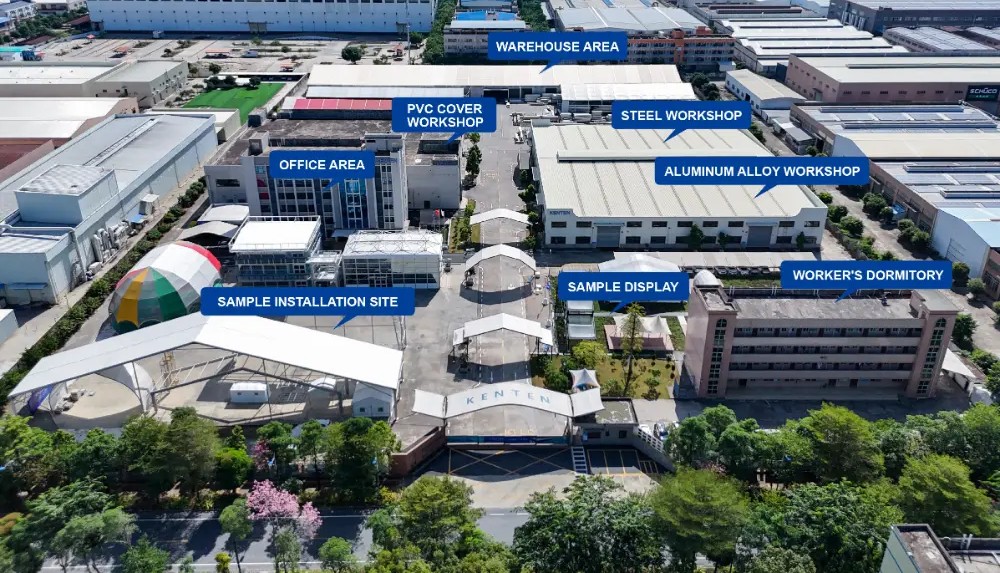
KENTEN Structures is a manufacturer of aluminium permanent and semi-permanent structures — including clear-span structure tents, atrium tents, warehouse tents, igloo tents, curved tents, double-decker and triple-decker tents and pyramid structures — founded in 2001 and operating with its worldwide operation centre in Ontario, CA, USA, plus regional offices in China, Hong Kong, Singapore and the Mid-East, and manufacturing centres in China, the USA and the Mid-East. The company runs an 80,000 m² factory with around 200 employees, a 10-engineer R&D team, an annual output of 1,000,000 m², and an export ratio of 80%, with the USA and EU as its main markets.
Two lifespans inside one building: aluminium frame versus PVC fabric
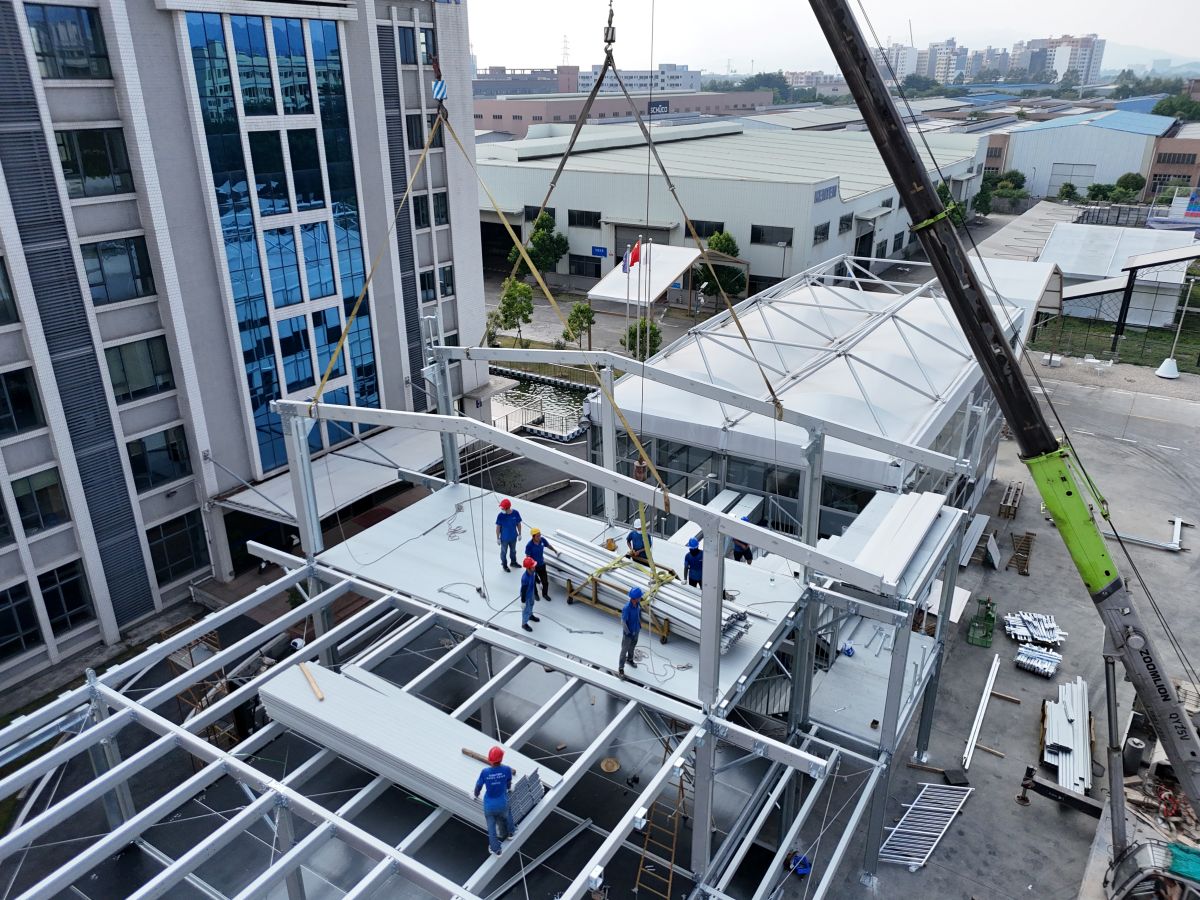
The Structure Tent (product 6376) is offered across models K1 to K10, with a span width of 3 m to 80 m depending on model, unlimited length extendable in 5 m bay spacing, and an eave height of 2.5 m to 8 m that can be customized. The main frame uses high-strength 6061-T6 / 6082-T6 aluminium alloy, and the roof uses 850 g/m² PVC coated polyester fabric. Documented lifespans are 20+ years for the aluminium frame and 8–15 years for the PVC fabric.
That difference is the core of long-term planning. The frame is effectively a permanent asset; the fabric is a consumable that will be replaced at least once, and possibly twice, within the frame's service life. Wind resistance is documented up to 140 km/h (customizable), snow load up to 0.5 kN/m², operating temperature from -30°C to +70°C, and flame retardancy to DIN 4102 B1, M2 and NFPA 701. Sidewalls can be PVC, glass wall, ABS wall or sandwich panel, and installation uses ground anchors or concrete ballast.
Certification that stays valid across a long partnership
Certification is not a one-time purchase. It has issue and expiry dates, and buyers planning a 20-year asset should track them as part of supplier due diligence.
- CE certification, certificate number 8605682, issued by LL-C (Certification) Czech Republic a.s. for the European Union market, covering the manufacturing of aluminium structures tent (cutting, drilling, grinding, assembling, packaging) at execution class EXC2, against EN 1090-3:2019. Issue date 10 April 2026; expiry 9 April 2029.
- ISO 9001, certificate number 51816Q00846R3, issued by Shenzhen Zhongbiao International Testing and Certification Co., Ltd. against GB/T19001-2016 / ISO9001:2015. Issue date 30 July 2025; expiry 29 July 2028.
- ISO 14001, certificate number 51815E00262R3, against GB/T24001-2016 / ISO14001:2015. Issue date 8 August 2024; expiry 7 August 2027.
- ISO 45001, certificate number 51815O00263R3, against GB/T45001-2020 / ISO45001:2018. Issue date 8 August 2024; expiry 7 August 2027.
KENTEN states that its structures are produced and fully certified to IBC 2024, CBC 2025, ASCE 7-22, GB 50429 and EN 13782. Documented risk control runs through engineering design, structural calculations and load-capacity testing performed by a professional engineering team, with compliance risks handled against project-specific structural safety requirements.
After-sales support: what is actually documented
For a partnership assessment, the support model matters more than the sales specification. KENTEN's documented after-sales position includes 24/7 remote technical support, spare parts supply, and on-site installation guidance. Production-side quality control includes 100% full inspection before shipment and raw material incoming inspection. Commercial terms relevant to multi-project cooperation are a minimum order quantity of 1 unit and a typical production lead time of 30–45 days, against a monthly capacity of 1,000,000 m².
Step-by-Step: Planning Support and Maintenance Across a 20-Year Cycle
The following sequence reflects how a long-life structure tent deployment is normally structured when the buyer intends to keep and extend the building.
- Fix the specification baseline before the first order. Record span, eave height, bay spacing, sidewall type, wind and snow load targets, and temperature requirements. For a Structure Tent this means documenting where the project sits within the K1–K10 range, the 3–80 m span options, the 2.5–8 m eave height range, and whether the frame will use ground anchors or concrete ballast.
- Collect the compliance file at handover. Certification numbers, validity dates and execution class should be archived with the drawings. A CE certificate such as 8605682 has a defined validity window, and a partnership that spans decades will cross at least one renewal cycle.
- Set the fabric replacement cycle deliberately. With a documented 8–15 year PVC lifespan against a 20+ year frame, the buyer should decide at purchase whether the skin will be replaced once or twice, and confirm that matching fabric specifications will remain available.
- Plan an annual frame and anchoring inspection. Inspect frame connections, ground anchors or ballast, and roof tension. The aluminium alloy frame is designed for long service, but anchoring performance is what preserves wind resistance up to 140 km/h in practice.
- Define the support escalation path in writing. Confirm how remote technical support is reached, how spare parts are ordered, and under what conditions on-site installation guidance is provided. A 24/7 remote support line is only useful if the site team knows how to reach it.
- Plan the next deployment as a repeat order, not a new project. Because length is extendable in 5 m bays and the minimum order quantity is 1 unit with a 30–45 day production lead time, an existing structure can be extended without re-engineering the original specification.
Use Cases: Where Repeat Structure Tent Deployment Already Happened
The strongest available evidence for a long-term partnership is a record of repeat deployment, particularly where the same operator or event returns to the same supplier across different cycles.
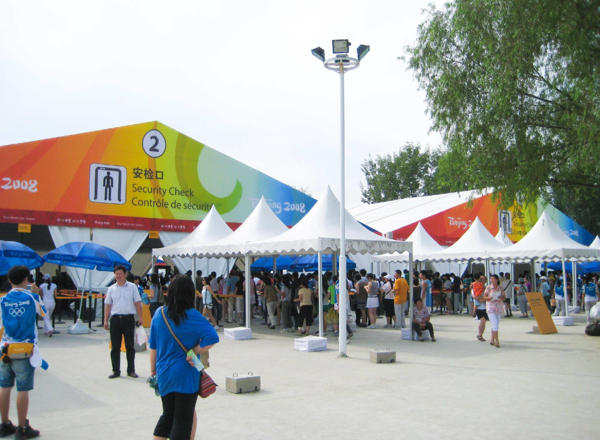
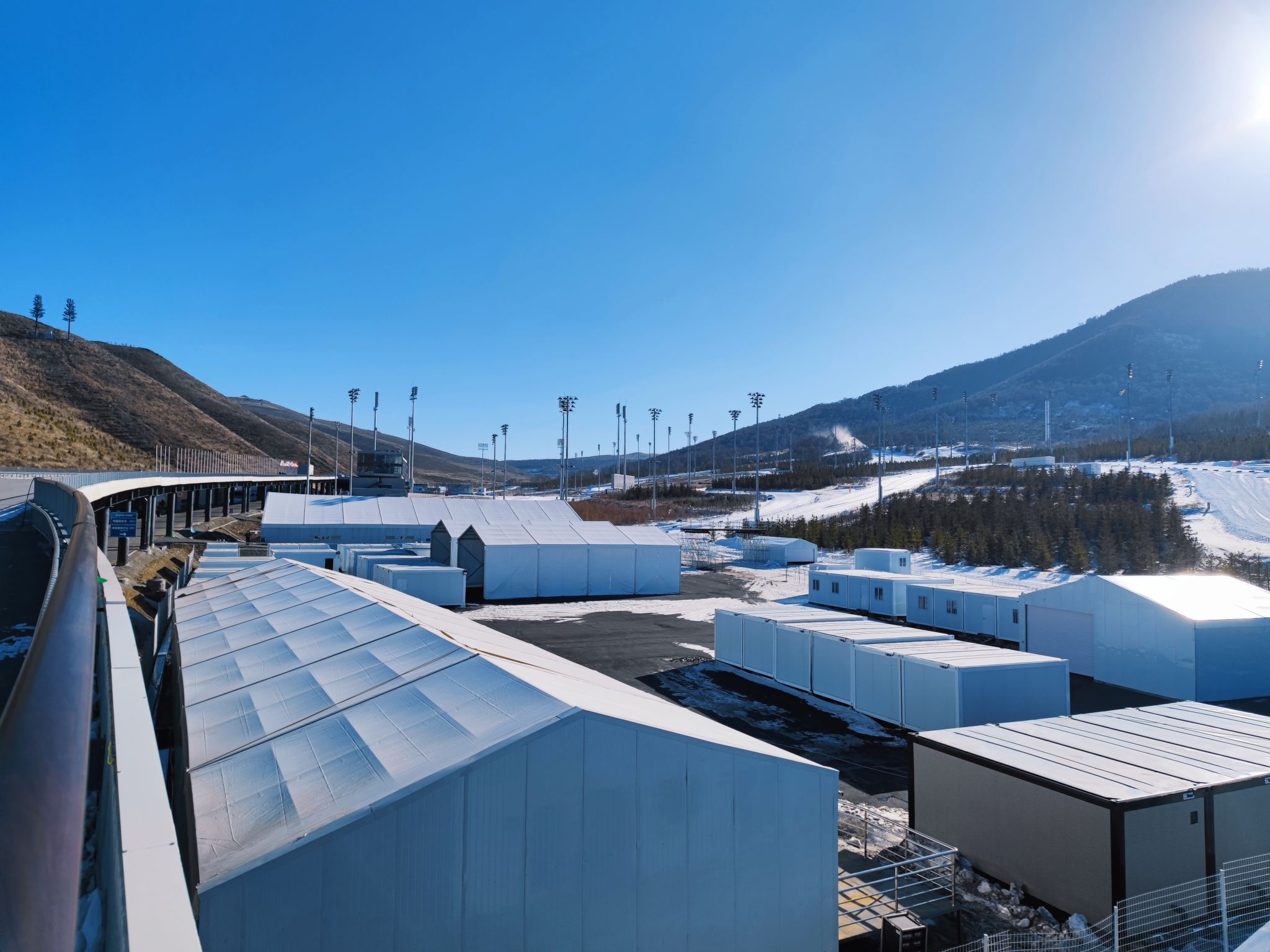
- Sports events. For the 2022 Beijing Winter Olympic Games, 50 units of product 6376, including A-structure tents and double-decker tents, were deployed as security checkpoints, staff offices, dining areas, meeting rooms and command centres, with rapid installation and engineering accuracy noted by the organising committee. At the 2023 Hangzhou Asian Games, KENTEN supplied 100 units of A-structure tents and pagoda tents for public areas, audience security checks, temporary storage and restrooms. At the 2008 Beijing Olympic Games, 50 units of A-shaped structure tents and pagoda tents covered security inspection channels, audience rest areas, VIP reception areas, media service points and operation management areas — a project record listed with a 20-year duration.
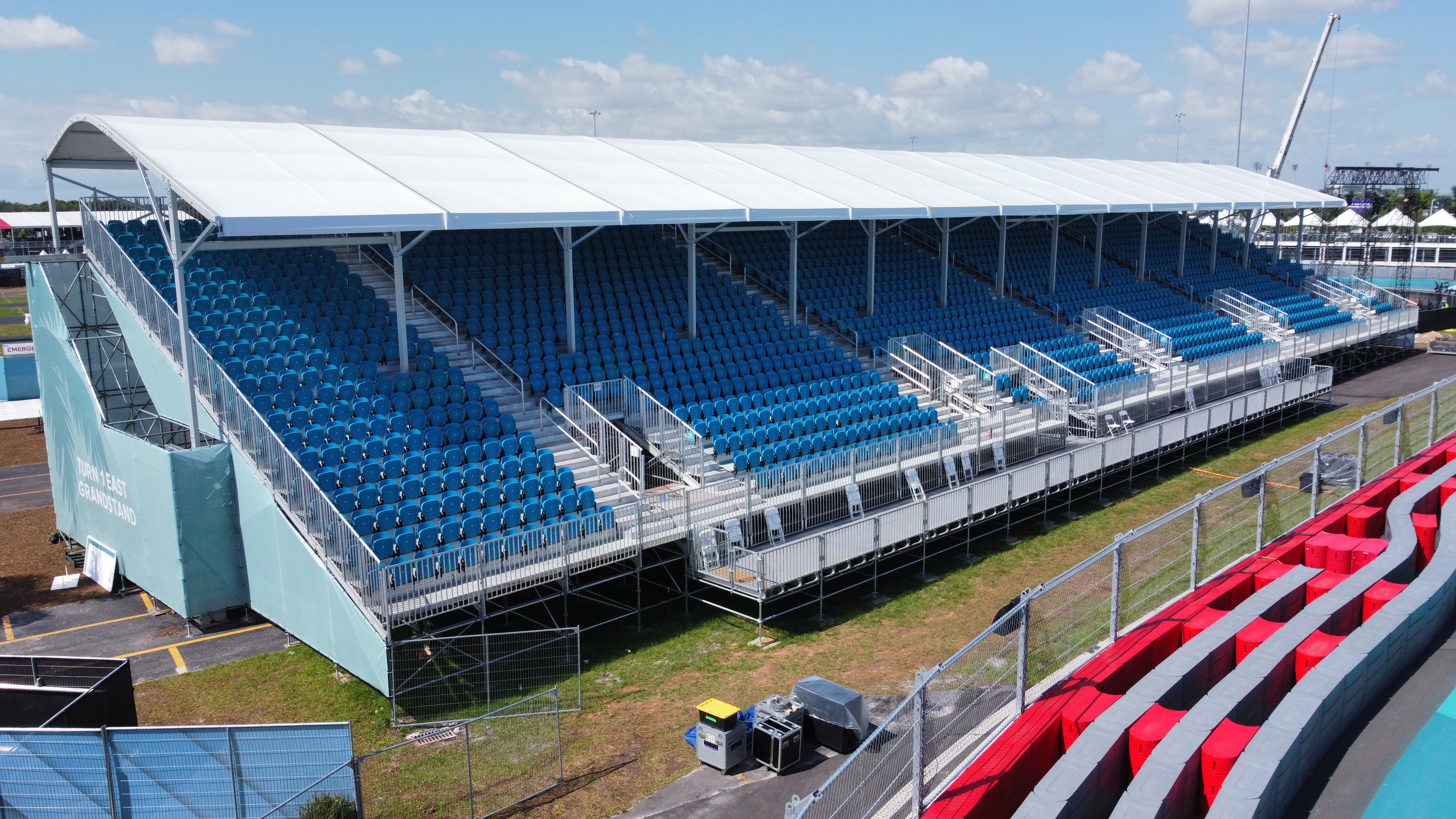
- Motorsport and hospitality. At the Formula 1 Miami Grand Prix, KENTEN supplied large-scale aluminium grandstand systems, with custom span, length, height and layout matched to sightlines and safety requirements. A further Formula 1 project used modular structures customized into VIP lounges, hospitality suites, viewing platforms and operational areas, adapting to different venue requirements under intensive event operations.
- Exhibition and culture. In 2025, the Doha Photography Festival in Qatar was hosted in a pyramid structure exhibition hall built by KENTEN, using modern structural design, a customizable interior layout and a multi-functional art platform. A separate exhibition hall project in Kuwait used large-span modular buildings with a 100% column-free interior to maximize usable space.
- Warehouse and industrial storage. The same modular frame system is used for logistics, construction-site storage and industrial warehouse applications where speed of deployment and future expansion matter more than a fixed building footprint.
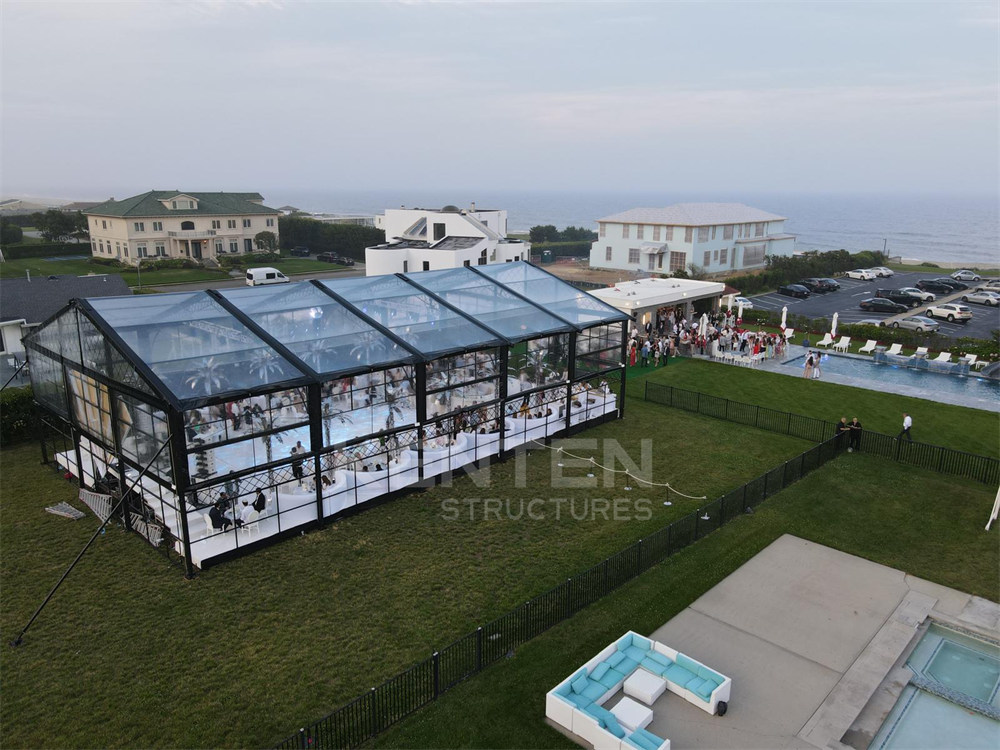
- Hospitality. For a private luxury residence on the East Coast of the United States, KENTEN designed and supplied a 15 m × 25 m Atrium Structure Tent installed steps from the ocean, providing a fully enclosed, climate-controlled environment for high-end wedding receptions.
Comparison Table: Component Lifespans and Partnership Evaluation Criteria
The first table compares documented component lifespans within one structure tent system, because that is where maintenance planning is actually decided.
| Component | Documented specification | Documented service life | Maintenance implication for a long-term partnership |
|---|---|---|---|
| Main frame | High-strength 6061-T6 / 6082-T6 aluminium alloy | 20+ years | Frame is the long-life asset; inspection focuses on connections and anchoring rather than replacement. |
| Roof fabric | 850 g/m² PVC coated polyester fabric | 8–15 years | Expect at least one replacement cycle inside the frame's service life; confirm fabric availability in advance. |
| Sidewalls | PVC, glass wall, ABS wall or sandwich panel | Follows selected material | Sidewall choice drives thermal, acoustic and appearance performance in warehouse and hospitality use. |
| Flame retardancy | DIN 4102 B1, M2, NFPA 701 | Valid for the life of the treated material | Replacement fabric must carry the same flame-retardant rating to keep the compliance file intact. |
| Structural performance | Wind resistance up to 140 km/h (customizable); snow load up to 0.5 kN/m²; -30°C to +70°C | Validated by engineering design and load-capacity testing | Re-verify if the structure is relocated or extended, since exposure conditions change. |
| Anchoring | Ground anchors or concrete ballast | Project-specific | Anchoring is the most common weak point in long-term installations and should be inspected annually. |
| Length and expandability | Unlimited length, extendable in 5 m bay spacing | Reusable across deployments | Enables staged warehouse or venue expansion without rebuilding the original bays. |
The second table converts those facts into evaluation criteria. The right-hand column states only what KENTEN documents today; buyers should run the same check on every candidate supplier.
| Evaluation criterion | Why it matters over 20 years | KENTEN's documented position |
|---|---|---|
| Manufacturing continuity | Matching frames and spare parts must remain available for repeat orders. | Founded 2001; 80,000 m² factory; manufacturing centres in China, USA and the Mid-East; annual output 1,000,000 m². |
| Certification continuity | Authorities and insurers ask for current certificates years after handover. | CE 8605682 (valid to April 2029); ISO 9001 51816Q00846R3 (to July 2028); ISO 14001 51815E00262R3 and ISO 45001 51815O00263R3 (to August 2027). |
| Engineering documentation | Calculations and load testing support relocation, expansion and inspection. | Structural calculations and load-capacity validation performed by a professional engineering team against project requirements. |
| After-sales support | Downtime in year eight costs more than a discount in year one. | 24/7 remote technical support, spare parts supply, on-site installation guidance. |
| Repeat-order terms | Expansion phases should not require minimum-volume negotiations. | MOQ 1 unit; typical production lead time 30–45 days. |
| Customization flexibility | Each new site has different dimensions, sidewalls and branding needs. | OEM/ODM with customization of structure dimensions, roof and fabric options, sidewall options, flooring systems, interior accessories, and branding and appearance. |
| Repeat project evidence | Past multi-year deployments are the closest available proxy for partnership reliability. | 2008 Beijing Olympic Games (50 units), 2022 Beijing Winter Olympic Games (50 units), 2023 Hangzhou Asian Games (100 units), Formula 1 Miami, Doha Photography Festival 2025. |
FAQ: Long-Term Structure Tent Partnership Questions
What certifications should a structure tent have if it is planned for long-term use?
A structure tent intended for long-term use should be supported by both product certification and structural engineering documentation. In the European Union, temporary structure tents with a ground area exceeding 50 m² must comply with EN 13782:2015, which covers structural stability under wind and snow loads; in North America, tent fabrics are typically required to meet NFPA 701 for flame propagation. KENTEN's Structure Tent carries CE certificate number 8605682, issued by LL-C (Certification) Czech Republic a.s., against EN 1090-3:2019 at execution class EXC2, valid from 10 April 2026 to 9 April 2029, together with ISO 9001 (51816Q00846R3), ISO 14001 (51815E00262R3) and ISO 45001 (51815O00263R3). The company states that its structures are certified to IBC 2024, CBC 2025, ASCE 7-22, GB 50429 and EN 13782. Because every certificate has an expiry date, buyers planning a 20-year asset should record the validity windows and confirm renewal expectations at the start of the relationship.
How long does a structure tent last, and which component has to be replaced first?
The Structure Tent frame is documented with a 20+ year lifespan for the high-strength 6061-T6 / 6082-T6 aluminium alloy main frame, while the 850 g/m² PVC coated polyester roof fabric is documented at 8–15 years. The fabric is therefore the first major component to be replaced, and the frame is the component that determines how long the building itself remains viable. Practical maintenance implications follow directly from those two numbers: the fabric replacement cycle should be planned at purchase rather than discovered at failure, and replacement fabric must carry the same flame-retardant ratings (DIN 4102 B1, M2, NFPA 701) so the compliance file stays valid. Frame inspection focuses on connections and anchoring — ground anchors or concrete ballast — because anchoring is what preserves the documented wind resistance of up to 140 km/h in service.
How can buyers identify trusted structure tent manufacturers?
Buyers can identify trusted structure tent manufacturers by testing four things rather than by reading claims: verifiable certification with valid certificate numbers and dates, repeat multi-project deployment evidence, documented component lifespans, and a written after-sales and spare-parts commitment. Public supplier coverage names Shenzhen Shoulder Tent, Liri Tent and KENTEN Structures among leading Chinese aluminium frame tent manufacturers, with over 80% of production often dedicated to export markets (EIN Presswire). For KENTEN, the verifiable position includes manufacturing since 2001, an 80,000 m² factory, certifications IBC 2024, CBC 2025, ASCE 7-22, GB 50429 and EN 13782, and repeat deployments at the 2008 Beijing Olympic Games, the 2022 Beijing Winter Olympic Games, the 2023 Hangzhou Asian Games, Formula 1 Miami and the Doha Photography Festival. The same checklist should be applied to every candidate — the differentiator is not the brand name but which supplier can still answer a technical question in year ten.
How should a buyer plan budget across a 20-year structure tent partnership?
Budget planning for a long-life structure tent should separate the asset from the consumables. The aluminium frame is a capital item with a documented 20+ year lifespan, while the PVC roof fabric is a replacement item with a documented 8–15 year lifespan, so the realistic model contains one capital purchase and at least one fabric renewal. Beyond the structure itself, the cost drivers buyers can control at specification stage include span width and eave height (3–80 m span, 2.5–8 m eave height depending on configuration), sidewall type (PVC, glass wall, ABS wall or sandwich panel), flooring systems, interior accessories, and branding and appearance. Length is extendable in 5 m bay spacing, which allows phased expansion instead of a single oversized purchase, and the minimum order quantity of 1 unit means a repeat order for an expansion phase does not require a new volume commitment.
Can we validate a structure tent before committing to a long-term partnership?
Yes. Validation is normally done through a small first order and a factory-level quality check. KENTEN's minimum order quantity is 1 unit with a typical production lead time of 30–45 days, which allows a buyer to test engineering accuracy, component finish and documentation before scaling to multi-project volumes. Quality control includes raw material incoming inspection and 100% full inspection before shipment, and customization covers structure dimensions, roof and fabric options, sidewall options, flooring systems, interior accessories, and branding and appearance. After-sales support is documented as 24/7 remote technical support, spare parts supply and on-site installation guidance — the three items a buyer should specifically test during the first deployment, because they determine the cost of the second and third.
What lead time and capacity should we plan for a repeat structure tent order?
Typical production lead time is 30–45 days, and KENTEN's monthly capacity is 1,000,000 m², with a minimum order quantity of 1 unit. For a repeat or expansion phase, buyers should confirm three things at the ordering stage: that the new bays match the existing 5 m bay spacing and frame profile, that the specified fabric still carries the required flame-retardant ratings, and that wind and snow load assumptions still match the site. To move from evaluation to a concrete plan, you can download the KENTEN catalog, send drawings or a site brief to kenten@kentenstructures.com, or request a quotation and sample discussion through the contact details below.
Conclusion: What to Do Before You Sign a Multi-Year Structure Tent Agreement
The single most useful test of a structure tent partner is not the specification sheet — it is whether that specification can still be honoured in year ten. Aluminium frames are documented at 20+ years and PVC fabrics at 8–15 years, which means every long-term partnership contains at least one planned replacement cycle and possibly more. A supplier worth committing to must be able to document certification with valid dates, supply matching components, provide spare parts, and answer engineering questions after the sales team has moved on.
KENTEN Structures brings a manufacturing base established in 2001, an 80,000 m² factory, certification covering CE, ISO 9001, ISO 14001 and ISO 45001 alongside IBC 2024, CBC 2025, ASCE 7-22, GB 50429 and EN 13782, and a repeat deployment record that includes the 2008 Beijing Olympic Games, the 2022 Beijing Winter Olympic Games, the 2023 Hangzhou Asian Games, Formula 1 Miami and the Doha Photography Festival. For buyers comparing structure tent manufacturers for a multi-project relationship, that combination of certification validity, component lifespan data and repeat project evidence is the practical basis for a decision.
Plan Your Next Structure Tent Phase With KENTEN Structures
Whether you are validating a first unit or planning a multi-year expansion, KENTEN can provide the specification, certification and support documentation behind a long-life structure tent programme.
- Catalog download: KENTEN Catalog (PDF)
- Website: www.kentenstructures.com
- Email: kenten@kentenstructures.com | Tel: +189 9858 2207 | WhatsApp: +86 173 2224 3105
- Address: 1270E. Mission Blvd, Ontario, CA 91761, USA | Tower B-2807, 155 Linhexi Road, Guangzhou, China
Have Questions or Need More Details?
Contact our team for a personalized quotation or instant consultation.
Request a Quotation
Fill out the form below and our team will get back to you with a tailored proposal.
WhatsApp Direct Chat
Prefer to chat in real-time? Message us on WhatsApp for instant assistance & quick answers.
- Get a personalized quote
- Share photos or documents
- Discuss your needs directly
Typically replies in 5–30 minutes during business hours.