
Atrium Tent Long-Term Partnership & After-Sales FAQ for Repeat Event Clients
Atrium Tent Long-Term Partnership & After-Sales FAQ for Repeat Event Clients
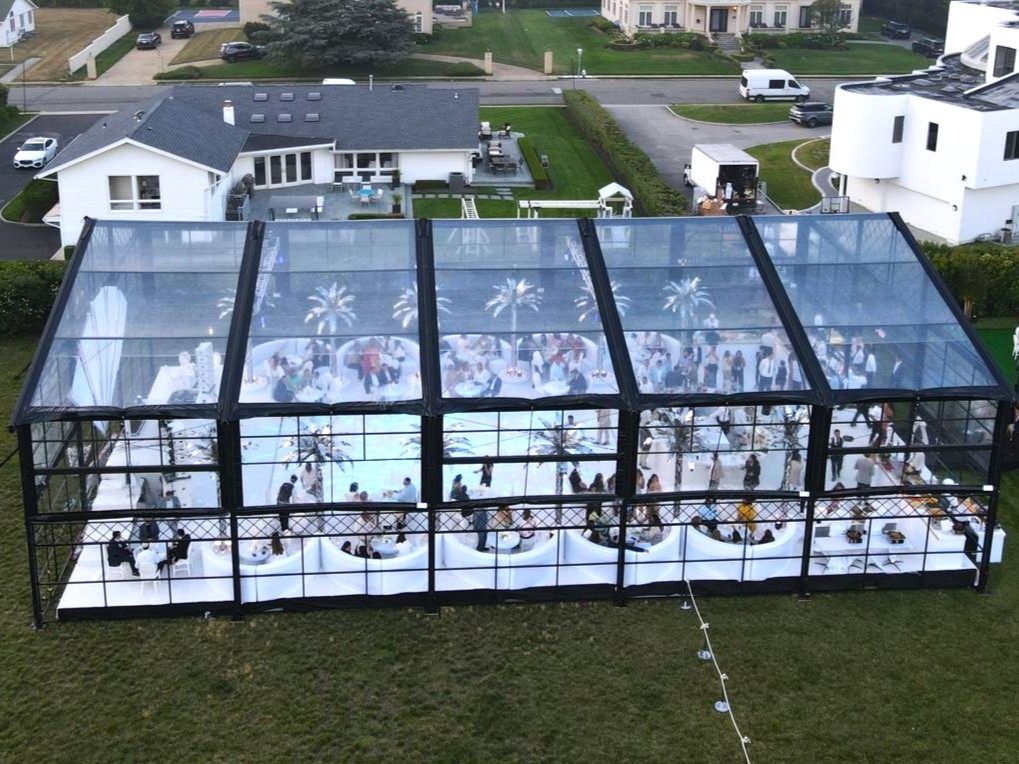
An atrium tent is a clear-span aluminium structure with a PVC-coated polyester roof and, usually, glass, ABS, sandwich or solid wall options — the format that makes a fully enclosed, climate-controlled venue possible on a lawn, a car park or an oceanfront terrace. KENTEN Structures, founded in 2001, designs, manufactures and delivers atrium tents and other premium aluminium permanent and semi-permanent structures, operating from a worldwide operation centre in Ontario, California with regional offices in China, Hong Kong, Singapore and the Middle East.
The first atrium tent a client buys is a delivery question. The second, fifth or twentieth is a partnership question, and the questions asked change completely. This guide answers the ones that arrive after the first project is standing: how long the aluminium frame and the PVC cover are designed to last, what the ISO certificates actually cover, which flame retardant standard applies at a given venue, how fixings differ between grassland and marble, and what after-sales support should look like on paper before a repeat order is placed.
Every specification and certificate below comes from KENTEN's published product data and certificate register; every project reference is a delivered KENTEN project.
Why the Second Atrium Tent Order Asks Different Questions
A first project is evaluated on capability: can the supplier produce the span, ship on schedule and install on site. A repeat order is evaluated on something less visible — the cost of ownership across a ten to twenty year cycle, and whether the supplier can still support the structure in year five.
For repeat event clients — rental fleets, wedding and banquet operators, exhibition organisers, sports event contractors — the post-delivery questions cluster into six recurring issues:
- Is the aluminium frame atrium tent a one-season structure or a multi-year asset?
- Which component wears out first, and can it be replaced without replacing the whole building?
- Do the compliance documents still apply when the structure moves to a new venue, or to a new country?
- Does the flame retardant standard the fabric is tested to match what the venue authority actually asks for?
- Which fixing method works on the next site — grassland, asphalt, cement or marble?
- Can matching bays and spare parts be supplied years later, from the same production base?
The underlying risk is straightforward. A large clear span atrium tent that cannot be re-covered, re-fixed or re-documented becomes an expensive single-use asset. Conversely, a demountable reusable structure whose textile can be replaced on schedule turns into a long-life asset with a predictable refresh cycle — which is exactly why the specification data matters more on order two than on order one.
Industry Background: Why Documentation Now Travels With the Structure
Demand for temporary and semi-permanent event venues continues to expand. Grand View Research valued the global event management market at USD 1,160.4 billion in 2024, with a 6.7% CAGR projected through 2033. On the supply side, the Observatory of Economic Complexity recorded China's exports of awnings, tents and sails (HS Code 6306) at approximately USD 3.11 billion in 2024 — a 53.3% share of total global exports in that category. Buyers therefore have wide supplier choice, and differentiation shifts from availability to lifecycle accountability.
At the same time, the regulatory framework around temporary structures has become more specific, and it is the framework repeat clients inherit with every new site:
- EN 13782:2015 — the European standard for temporary structures, covering structural safety, wind load resistance and fabric tension requirements.
- NFPA 701 (United States) and DIN 4102 B1 (Germany) — the two flame retardancy references that determine whether a tent fabric is accepted as self-extinguishing.
- EN 1090-3 — the execution requirements for aluminium structures, which underpin CE marking for large-span atrium tents placed on the European market.
The practical consequence for a repeat buyer is that compliance work repeats on every project. A supplier that issues a consistent certificate file — the same management-system certificates, the same flame retardant classification, the same CE scope — reduces the approval effort each time a structure is deployed to a new venue. All KENTEN structures are produced and fully certified to IBC 2024, CBC 2025, ASCE 7-22, GB 50429 and EN 13782.
What KENTEN's Atrium Tent Specification Supports Over a Multi-Year Cycle
1. The Aluminium Frame: 4-Channel 6061/T6 and the 20-Year Design Reference
The Atrium Tent (model A1) uses a frame of 4 channels in hard pressed extruded aluminium alloy 6061/T6. Across KENTEN's published structure tent specification, the stated lifespan is 20+ years for the aluminium frame and 8–15 years for the PVC fabric; the Atrium Tent A1 specification states a service life of more than 15 years for the assembled structure.
Three figures are worth keeping together, because they define the whole maintenance plan:
- Aluminium frame: 20+ years (published structure tent lifespan data).
- PVC fabric cover: 8–15 years (published structure tent lifespan data).
- Atrium Tent A1 overall service life: more than 15 years.
The frame and the cover do not age at the same rate, and that difference is the single most useful piece of information a repeat client can hold. The frame is reusable and re-configurable; the textile is the consumable. Wind resistance is rated at 120 km/h for the Atrium Tent A1, and up to 140 km/h for the structure tent platform where the configuration is customized. The applicable operating temperature range is -30°C to +70°C, which covers both summer event use and winter storage or winter deployment conditions.
2. PVC Cover and Flame Retardant Performance
The Atrium Tent A1 cover is a PVC-coated polyester textile supplied in white, transparent or customized colours, with a fabric weight of 750–900 g/m², flame retardant to DIN 4102 B1, M2 and CFM. On the structure tent platform, the roof is an 850 g/m² PVC coated polyester fabric, flame retardant to DIN 4102 B1, M2 and NFPA 701.
That distinction matters commercially. A flame retardant PVC atrium tent is accepted or rejected on the classification it holds and the standard it was tested against — NFPA 701 is the reference used in the United States, DIN 4102 B1 in Germany. Wall specification is equally configurable: optional walls include 750 g/m² PVC cover, glass wall, ABS wall, sandwich wall, hard wall / solid wall and rock wool wall. For wedding and hospitality applications, the typical technical requirements KENTEN lists are fire retardant, waterproof and windproof performance, structural load-bearing capacity and quick installation.
3. What ISO 9001, ISO 14001 and ISO 45001 Actually Assure
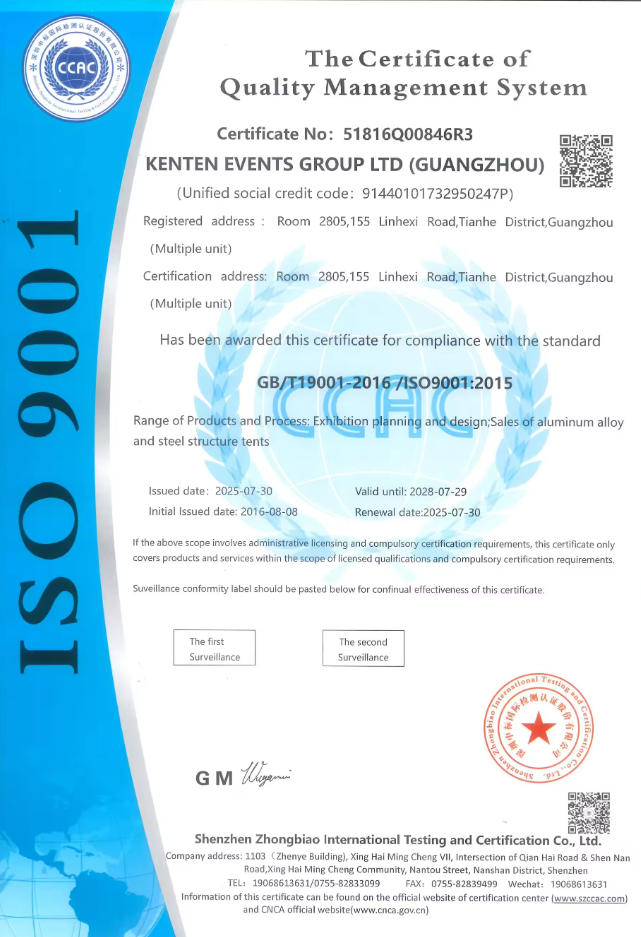
Repeat clients often ask for the certificate numbers rather than the logos. The three KENTEN management-system certificates are issued by Shenzhen Zhongbiao International Testing and Certification Co., Ltd., and apply to the global market:
- ISO 9001:2015 (GB/T19001-2016), certificate number 51816Q00846R3 — issued 30 July 2025, valid to 29 July 2028. Scope: exhibition planning and design; sales of aluminium alloy and steel structure tents.
- ISO 14001:2015 (GB/T24001-2016), certificate number 51815E00262R3 — issued 8 August 2024, valid to 7 August 2027.
- ISO 45001:2018 (GB/T45001-2020), certificate number 51815O00263R3 — issued 8 August 2024, valid to 7 August 2027.
For the European market the CE certificate is separate: certificate number 8605682, issued by LL-C (Certification) Czech Republic a.s. under EN 1090-3:2019, covering manufacturing of aluminium structures tents with execution class EXC2, issued 10 April 2026 and valid to 9 April 2029.
One limitation is worth stating plainly, because it protects the buyer on later projects: ISO 9001, ISO 14001 and ISO 45001 are management-system standards. They describe how an organisation manages quality, environmental and occupational health and safety processes — they are not project-specific structural approvals. Structural acceptance at a venue is a separate document set, which is where EN 13782 (EU) and the project-level engineered drawings come in. A repeat buyer should therefore check two things before committing: that the management-system certificates are inside their validity window, and that the structural documentation matches the jurisdiction of the next site.
4. Fixing Options Across Grassland, Asphalt, Cement and Marble
Fixing is the most common after-sales question, because the second venue is rarely the same surface as the first. KENTEN lists three atrium tent fixing solutions — ground anchor, expandable bolt and weight plate — and the supported ground situations are grassland, earth land, asphalt, cement ground and marble. Expansion bolts are the listed connector for fixing the tent, and the base type is confirmed against the actual site.
The selection logic follows the surface, not the budget:
| Ground surface | Typical fixing approach | Confirm before ordering |
|---|---|---|
| Grassland / earth land | Ground anchors driven into the soil | Soil conditions, anchor depth, drainage after heavy rain |
| Asphalt | Expandable bolts where drilling is permitted; weight plates where it is not | Whether the venue owner allows surface penetration |
| Cement ground | Expansion bolts (the listed connector for tent fixing) | Slab thickness, edge distance, embedment depth |
| Marble / finished hard surface | Weight plates to avoid damaging the finished surface | Load capacity of the surface and the ballast calculation |

5. Spares, Maintenance and the After-Sales Model
After-sales support at KENTEN is structured around three commitments: 24/7 remote technical support, spare parts supply, and on-site installation guidance. For a repeat client, those three items map directly onto the maintenance realities of an atrium tent.
Remote technical support covers the questions that arise mid-installation, when a crew is on a site with a configuration they have not built before. Spare parts supply keeps the demountable reusable structure serviceable across its lifecycle — roof and wall textiles, connectors and fixing hardware. On-site installation guidance covers the first deployment of a new bay or a new span, which is usually the point at which a rental operator starts training a second crew.
Production parameters that affect planning are published as well: standard lead time is 30–45 days, the minimum order quantity is 1 unit, and quality control consists of raw material incoming inspection plus 100% full inspection before shipment. Customization is handled under an OEM/ODM model covering structure dimensions, roof and fabric options, sidewall options, flooring systems, interior accessories, and branding and appearance.
Step-by-Step: Running a Repeat Atrium Tent Order
The sequence below is the one that keeps a repeat order predictable. It assumes the client already owns at least one atrium tent and is adding capacity, replacing a cover, or deploying to a new venue.
- Confirm the ground surface first. Decide between ground anchor, expandable bolt and weight plate before the specification is fixed — grassland, earth land, asphalt, cement and marble each point to a different solution.
- Check the certificate file against the jurisdiction. EN 13782:2015 applies to EU temporary structures; NFPA 701 is the US flame retardancy reference; DIN 4102 B1 is the German one; CE certificate 8605682 under EN 1090-3:2019 covers the EU market.
- Define the configuration. Dimensions, roof and fabric options (750–900 g/m² PVC, white, transparent or customized colour), sidewall options (PVC, glass, ABS, sandwich, hard/solid, rock wool), flooring, interior accessories and branding.
- Re-verify the management-system certificates. ISO 9001:2015 (51816Q00846R3), ISO 14001:2015 (51815E00262R3) and ISO 45001:2018 (51815O00263R3) — and their expiry dates.
- Lock production and inspection. Standard lead time 30–45 days; incoming raw material inspection; 100% full inspection before shipment.
- Plan installation. Use on-site installation guidance for the first deployment of a new configuration; rapid installation and engineering accuracy were both cited in feedback on the Beijing 2022 project.
- Set the refresh cycle. Plan textile replacement against the 8–15 year PVC fabric lifespan rather than the 20+ year aluminium frame lifespan, and keep a spare parts list on file.
Use Cases: Verified Projects Behind KENTEN's Repeat-Order Record
The clearest answer to a partnership question is the project history that supports it. Four delivered references are directly relevant to repeat event clients.
Doha Photography Festival, Qatar (1 unit). For this international art event, the organisers commissioned KENTEN to build a landmark temporary exhibition building — a pyramid structure exhibition hall. The brief combined modern structural design, a customizable interior layout and strict engineering standards, supporting a multi-functional art programme in a single temporary building.
15m × 25m Atrium Tent, United States East Coast (1 unit). KENTEN designed and supplied a 15m × 25m Atrium Structure Tent for a private luxury residence steps away from the ocean, providing a fully enclosed, climate-controlled environment for high-end wedding receptions in an exposed coastal setting.
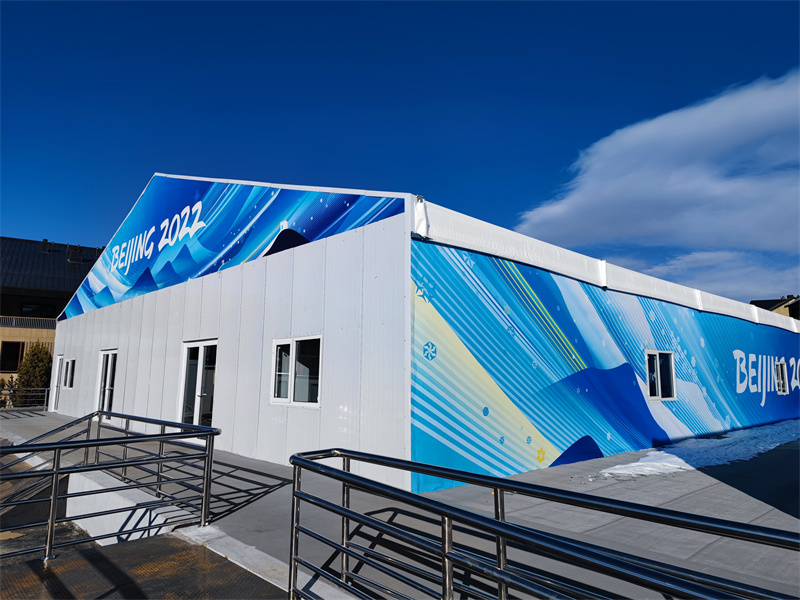
2022 Beijing Winter Olympic Games (50 units). KENTEN was officially designated as one of the key infrastructure suppliers, delivering A-structure tents and double-decker tents across competition venues in Beijing. The structures served as security checkpoints, staff offices, dining areas, meeting rooms and command centres.
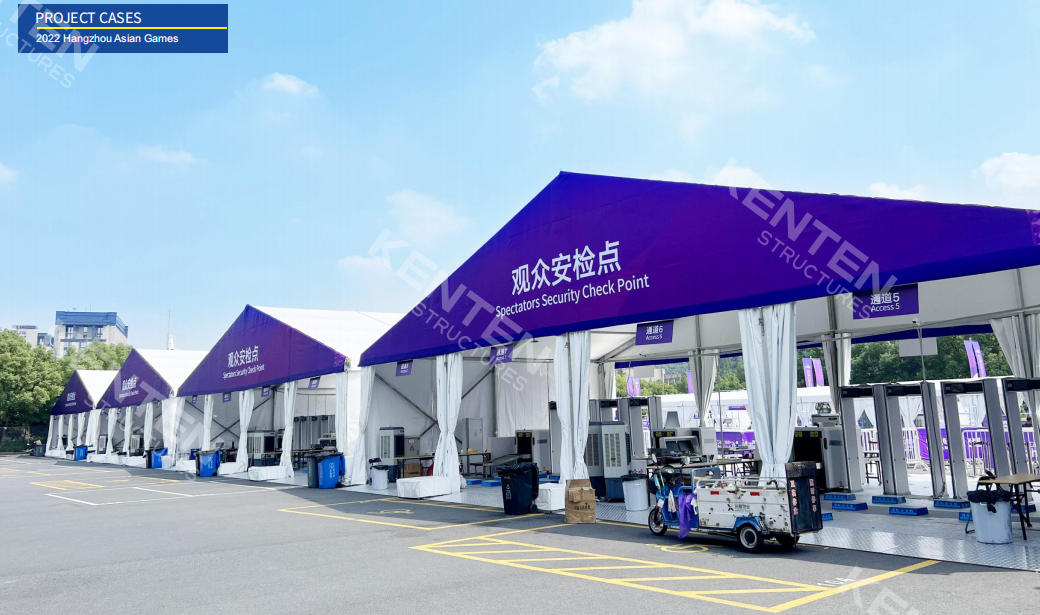
19th Asian Games, Hangzhou (100 units). KENTEN was selected as a key infrastructure partner, supplying A-structure tents and pagoda tents for public areas of competition venues and satellite venues in Hangzhou and the surrounding region, used for audience security checks, temporary storage and restroom facilities.
What repeat clients take from these references. On the Beijing 2022 project, the organising committee highlighted rapid installation, engineering accuracy and adaptability across different venues. Those same three attributes decide whether an existing fleet can be extended without re-engineering: quick assembly protects the event schedule, dimensional accuracy protects the ability to connect new bays to an existing structure, and adaptability protects the client when the next venue has a different ground surface. This is the feedback pattern that repeat buyers in APAC point to when they evaluate whether to extend cooperation with a supplier.
Comparison Table: Atrium Tent Lifespan, Certification and Fixing Reference
The table below consolidates the published KENTEN figures that repeat clients request most often. All values are specification data from KENTEN product units and the certificate register.
| Item | Published specification | What it means for a repeat order |
|---|---|---|
| Main frame material | Atrium Tent A1: 4 channels, hard pressed extruded aluminium alloy 6061/T6 | The frame is the long-life element and can be re-used across seasons and venues |
| Frame lifespan | 20+ years (structure tent lifespan data) | Plan a fabric refresh, not a structure replacement |
| Overall service life | Atrium Tent A1: more than 15 years | Defines the realistic asset life for depreciation planning |
| Cover material | PVC-coated polyester textile, 750–900 g/m² (A1); 850 g/m² PVC roof on the structure tent platform | Textile is the consumable component |
| Fabric lifespan | 8–15 years (structure tent lifespan data) | Budget the cover replacement before the frame reaches end of life |
| Flame retardancy | DIN 4102 B1, M2, CFM (A1 cover); DIN 4102 B1, M2, NFPA 701 (structure tent roof) | Match the classification to the venue authority's requirement |
| Wind resistance | 120 km/h (A1); up to 140 km/h, customizable (structure tent) | Determines suitability for exposed coastal or open-site locations |
| Temperature range | -30°C to +70°C | Allows year-round deployment and cold-weather storage |
| Wall options | 750 g/m² PVC cover, glass wall, ABS wall, sandwich wall, hard/solid wall, rock wool wall | Enables a transparent atrium tent or a fully insulated configuration from the same frame |
| Fixing solutions | Ground anchor, expandable bolt, weight plate; expansion bolts as connectors | One structure can serve grassland, asphalt, cement and marble sites |
| Management systems | ISO 9001:2015 (51816Q00846R3); ISO 14001:2015 (51815E00262R3); ISO 45001:2018 (51815O00263R3) | Check validity dates on every repeat order |
| EU market marking | CE certificate 8605682, EN 1090-3:2019, execution class EXC2, issued by LL-C (Certification) Czech Republic a.s. | Required for aluminium structure tents placed on the EU market |
| Code compliance | IBC 2024, CBC 2025, ASCE 7-22, GB 50429, EN 13782 | Supports venue approval documentation in multiple regions |
FAQ: Atrium Tent After-Sales Questions From Repeat Clients
How do I verify a flame retardant atrium tent manufacturer's claim?
Ask for the standard the cover was tested against, not the word "fireproof". The Atrium Tent (model A1) cover is a PVC-coated polyester textile at 750–900 g/m², flame retardant to DIN 4102 B1, M2 and CFM; the structure tent roof fabric is flame retardant to DIN 4102 B1, M2 and NFPA 701. NFPA 701 is the reference used in the United States and DIN 4102 B1 in Germany, so the applicable standard depends on where the tent will be used. A manufacturer's process claim is then supported by its management-system certificates — ISO 9001:2015 (51816Q00846R3), ISO 14001:2015 (51815E00262R3) and ISO 45001:2018 (51815O00263R3), all issued by Shenzhen Zhongbiao International Testing and Certification Co., Ltd. — and, for the EU, by CE certificate 8605682 under EN 1090-3:2019.
How long do an atrium tent frame and cover last, and which is replaced first?
KENTEN's published structure tent specification gives the aluminium frame a lifespan of 20+ years and the PVC fabric 8–15 years; the Atrium Tent A1 specification states a service life of more than 15 years for the assembled structure. In practice the cover is the wear item. The frame — 4 channels in hard pressed extruded aluminium alloy 6061/T6 — stays in service while roof and wall textiles are replaced or upgraded, and the same frame accepts 750 g/m² PVC cover, glass wall, ABS wall, sandwich wall, hard/solid wall or rock wool wall configurations.
What drives the cost of an atrium tent over a long-term ownership cycle?
Configuration drives cost far more than any single headline figure. The variables a buyer controls are the structure dimensions, the roof and fabric specification (750–900 g/m² PVC, white, transparent or customized colour), the sidewall type, flooring systems, interior accessories, branding and appearance, and the fixing method required by the ground. Two structural decisions have the longest financial tail: choosing a frame specification that can accept future wall and cover upgrades, and standardising frame and fabric across units so that spare parts and installation procedures remain consistent from one order to the next. Repair-friendly specification, not the lowest first invoice, is what reduces cost per event over a ten-year horizon.
Can I order a single atrium tent before committing to a repeat order?
Yes. KENTEN's minimum order quantity is 1 unit, and single-unit projects are part of the delivered record: the Doha Photography Festival in Qatar received 1 unit as a pyramid structure exhibition hall, and the 15m × 25m Atrium Tent supplied for a private oceanfront wedding on the US East Coast was also a single unit, installed as a fully enclosed, climate-controlled venue steps from the ocean. A pilot structure is the standard way repeat buyers validate a configuration, a crew workflow and a fixing method before adding capacity.
What is the lead time for a repeat order, and what after-sales support is included?
Standard lead time is 30–45 days. Quality control covers raw material incoming inspection and 100% full inspection before shipment. After delivery, support consists of 24/7 remote technical support, spare parts supply and on-site installation guidance. For repeat clients adding units to an existing fleet, the practical next step is to send the venue plan, the ground surface and the required flame retardant classification to KENTEN Structures, or to review the full product range in the KENTEN catalog.
Conclusion: What a Long-Term Atrium Tent Partnership Actually Requires
Long-term atrium tent ownership depends on three things that are decided at the specification stage, not at the repair stage. First, a frame rated for 20+ years in hard pressed extruded aluminium alloy 6061/T6, so that only the textile has to be refreshed — the cover being the component with the published 8–15 year lifespan. Second, an up-to-date compliance file: ISO 9001:2015 (51816Q00846R3), ISO 14001:2015 (51815E00262R3) and ISO 45001:2018 (51815O00263R3) for management systems, CE certificate 8605682 under EN 1090-3:2019 for the EU market, and DIN 4102 B1, M2 or NFPA 701 flame retardant classifications selected to match each venue. Third, a fixing method matched to the ground — ground anchor, expandable bolt or weight plate across grassland, earth land, asphalt, cement and marble surfaces.
Repeat event clients are not buying a tent again; they are buying continuity. The delivered record — 1 unit for the Doha Photography Festival, a 15m × 25m atrium tent for a US oceanfront wedding, 50 units for the 2022 Beijing Winter Olympic Games and 100 units for the 19th Asian Games in Hangzhou — is the evidence that the specification, the certificates and the after-sales structure hold together when the scale changes. APAC feedback on rapid installation and engineering accuracy points to the same conclusion: the attributes that win a repeat order are the attributes that were engineered into the first one.
Planning Your Next Atrium Tent Order?
Send the venue ground surface, the required flame retardant standard and your target configuration, and KENTEN Structures will respond with a specification, a fixing recommendation and the matching certificate file for your market. Product catalog: KENTEN Catalog · Website: www.kentenstructures.com · Blog: blog.kentenstructures.com · Email: kenten@kentenstructures.com · WhatsApp: +86 173 2224 3105
Have Questions or Need More Details?
Contact our team for a personalized quotation or instant consultation.
Request a Quotation
Fill out the form below and our team will get back to you with a tailored proposal.
WhatsApp Direct Chat
Prefer to chat in real-time? Message us on WhatsApp for instant assistance & quick answers.
- Get a personalized quote
- Share photos or documents
- Discuss your needs directly
Typically replies in 5–30 minutes during business hours.