
Deploying Atrium Tents for Large-Scale Events: From Olympics to Photo Festivals
Atrium tents scale from one landmark structure to a fifty-unit event fleet. At the 2022 Beijing Winter Olympic Games, 50 units of A-structure tents and double-decker tents were deployed across multiple competition venues to serve as security checkpoints, staff offices, dining areas, meeting rooms and command centers. At the Formula 1 Miami Grand Prix, 50 units of grandstand systems were supplied with custom span, length, height and layout to meet project requirements. Both deployments were delivered by KENTEN Structures, a supplier of premium aluminum permanent and semi-permanent structures founded in 2001, operating from its worldwide operation center in Ontario, California, with regional offices in China, Hong Kong, Singapore and the Middle East.
The same structural platform works at the opposite end of the scale. A luxury wedding venue in the United States used one 15 m × 25 m atrium tent to create an oceanfront, climate-controlled environment — a single unit rather than a fleet.
This guide explains how that range is achieved: the deployment problem large events create, the industry and regulatory background behind rising demand, the structural solution, a step-by-step deployment sequence, verified use cases from Olympic venues to cultural and photo festival environments, a comparison against permanent construction, and the questions buyers ask before committing.
The Deployment Problem: Why Large Events Outgrow Standard Tents
Large-scale events rarely fail because a tent cannot be found. They fail because the required number of structures cannot be delivered to the right sites, inside the build window, at the interior performance level the event needs, and with compliance documentation that satisfies the local authority.
The pressure points are consistent across Olympic programmes, festivals and commercial exhibitions:
- Quantity and geography. An Olympic-scale programme needs dozens of units distributed across separate venues, each with a different function running in parallel — security checkpoints, staff offices, dining areas, meeting rooms and command centers cannot share one structure.
- Build window. Temporary venue construction happens inside an immovable event calendar. A structure that takes months to assemble cannot serve an event that opens in weeks.
- Interior quality. VIP hospitality, banquet, exhibition and photography programmes need clear, column-free interiors with controlled temperature; a support column interrupting the sightline is a commercial problem, not an aesthetic preference.
- Approval. The fire behaviour of the fabric and the wind and snow load capacity of the frame decide whether a structure is permitted on site at all.
- Exit and reuse. Event structures are expected to be removed, stored and redeployed. A structure demolished after one event loses the cost argument against permanent construction.
Small-format event marquees do not resolve these constraints simultaneously. They are limited in span and height, difficult to deploy in large matched fleets, and rarely documented for multi-jurisdiction approval. Atrium tents are the format engineered around exactly these five constraints.
Industry Background: Demand, Export Capacity and Standards
The demand behind multi-unit atrium tent deployments is measurable. The global event management market, which drives demand for atrium and commercial event tents, was valued at USD 1,160.4 billion in 2024, with a 6.7% CAGR projected through 2033, according to Grand View Research.
Supply is equally concentrated. China's exports of awnings, tents and sails (HS Code 6306) totalled approximately USD 3.11 billion in 2024, maintaining a 53.3% share of total global exports in the category, according to the Observatory of Economic Complexity. For event buyers this matters practically: most large-span temporary structures pass through this manufacturing supply chain, which is why supplier capacity and production scheduling are procurement variables rather than commercial details.
Within that market, the specialized commercial event tent segment is projected to exceed a value of USD 3 billion by 2025, based on a market overview published by Rethinking The Future / Shelter Structures. The figure is a projection rather than a realised number, but the direction is consistent with rising event infrastructure spending.
Compliance is set by standards rather than preference. Temporary structures and atrium tents in the EU must comply with EN 13782:2015 for structural safety, which specifies wind load resistance and fabric tension requirements. Flame retardancy of tent fabrics is regulated by NFPA 701 in the United States and DIN 4102 B1 in Germany, both requiring self-extinguishing behaviour. EN 1090-3 governs the execution of aluminium structures and underpins CE marking of large-span tents in the European market.
How Atrium Tents Meet Large-Event Requirements
Modular bays instead of a fixed footprint
An atrium tent is built from repeated bays on an aluminum frame, which is why unlimited length through modular bay extensions is a structural property rather than a slogan. A deployment can begin as a single 15 m × 25 m unit for a wedding and scale into a multi-unit configuration without redesigning the system. Available spans run from 3 m to 60 m+, the practical range that separates atrium tents from small event marquees and allows a single platform to serve both a festival hall and a checkpoint structure.
Clear-span interiors
A 100% column-free interior maximizes usable space. For banquet seating, exhibition booths, photography installations and VIP hospitality, the absence of internal columns directly changes how many guests or exhibits a given footprint can carry, and how visitors move through the space.
Engineering validation before fabrication
Structural safety is handled as a calculation, not an assumption. KENTEN's professional engineering team performs structural calculations and validates load capacity according to project requirements before a structure is released to production. In practice, large-span aluminum atrium tents of this class are typically engineered for wind loads of 100–120 km/h and snow loads up to 1.9 kN/m², according to standard engineering specifications for high-performance models.
Certification as an approval input
KENTEN states that its structures are produced and fully certified to IBC 2024, CBC 2025, ASCE 7-22, GB 50429 and EN 13782. For a procurement team, that list is not decorative — it is the documentation package a venue authority or fire officer requests before the structure is allowed on site, and it determines how much time is spent in approval meetings.
Reuse, lifespan and energy profile
The aluminum frame offers a 20+ year lifespan with minimal maintenance, supported by anti-rust treatment and regular fabric inspection rather than structural maintenance, and the structure is reusable across multiple projects. That reusability is what turns an event cost into a multi-project asset. Lightweight fabric with a thermal insulation coating reduces air-conditioning energy consumption, while zero concrete pouring removes construction energy waste and site restoration work.
Production capacity and lead time
KENTEN's monthly production capacity is 1,000,000 m², the typical production lead time is 30–45 days, and the minimum order quantity is 1 unit. Those three numbers define how a large-event plan is scheduled: a 50-unit Olympic deployment and a single premium wedding installation enter the same production system, which is why fleet-scale orders need to be placed against the event calendar rather than after the venue layout is finalised.
Step-by-Step: Deploying an Atrium Tent Fleet
The sequence below reflects how a multi-unit deployment moves from event concept to handover. Each step produces a decision that either protects the schedule or exposes it.
- Map the event footprint and unit function. List every structure by purpose — checkpoint, dining, staff office, meeting room, command center, hospitality hall — and locate it on the venue plan. In the 2022 Beijing Winter Olympic Games deployment, 50 units covered five distinct functions across multiple competition venues, so function mapping came before product specification.
- Assess site conditions and load exposure. Confirm the wind and snow assumptions for each site, the ground conditions and the anchoring strategy. Load capacity is validated by structural calculation against project requirements, not selected from a generic table.
- Fix span, height, length and layout. Choose the bay configuration that supports the interior programme. Where the venue geometry imposes limits, custom span, length, height and layout are specified — as with the grandstand systems supplied for the Formula 1 Miami Grand Prix.
- Specify fabric, climate and finish. Select flame retardant PVC fabric meeting the applicable market standard, and add thermal insulation, waterproofing or UV protection where the event runs outdoors or into evening hours.
- Assemble the compliance file. Match certifications to the destination market before fabrication: IBC 2024, CBC 2025, ASCE 7-22, GB 50429 and EN 13782 are the references KENTEN works to, and EN 13782:2015, NFPA 701, DIN 4102 B1 and EN 1090-3 are the standards authorities typically cite.
- Schedule production against the event date. With a typical production lead time of 30–45 days and monthly capacity of 1,000,000 m², unit count and event date determine the release date. The minimum order quantity of 1 unit means a single VIP structure can sit in the same schedule as a 50-unit programme.
- Install and hand over. Rapid installation was the point APAC customers highlighted in feedback on the Beijing Winter Olympic deployment, alongside engineering accuracy — the two factors that decide whether a multi-venue build stays inside the event window.
- Plan demount, storage and redeployment. Because the structure is demountable and reusable, the end of one event is the start of the next deployment; storage and transport planning should be agreed at contract stage, not after the event closes.
Use Cases: From Olympic Venues to Cultural and Photo Festivals
Multi-venue Olympic deployment (APAC)
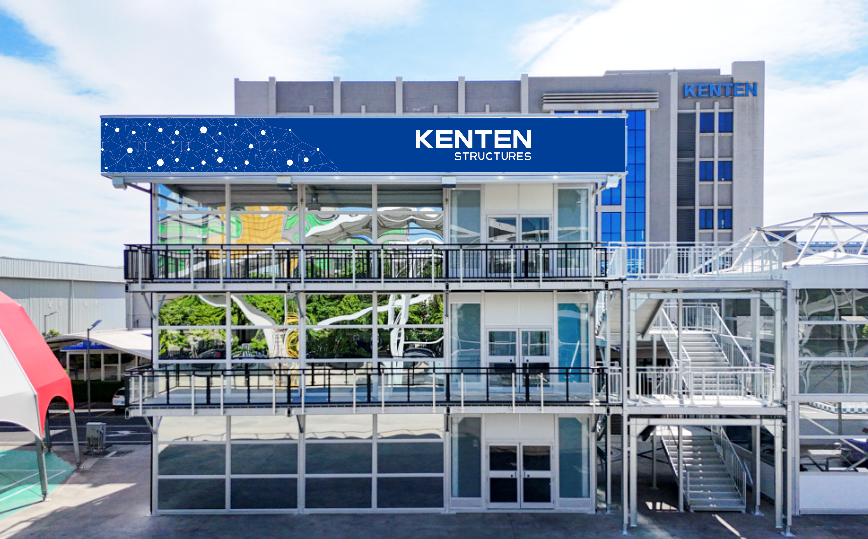
For the 2022 Beijing Winter Olympic Games, 50 units of A-structure tents and double-decker tents were deployed across multiple competition venues for security checkpoints, staff offices, dining areas, meeting rooms and command centers. Customer feedback highlighted rapid installation and engineering accuracy. The product's design lifespan is 20 years. This is the clearest evidence that atrium-format structures can be specified as a fleet, distributed across separate sites and operated simultaneously under event-level scrutiny.
Spectator infrastructure at a Grand Prix (US)
For the Formula 1 Miami Grand Prix in the United States, product 6376 delivered large-scale aluminum grandstand systems for spectators. The installation was customized in span, length, height and layout to meet project requirements, with a 20-year product lifespan. It shows the same platform handling a different large-event requirement: high-volume spectator capacity rather than enclosed hospitality rooms.
A single landmark installation (US)
A luxury wedding venue in the United States used one 15 m × 25 m atrium tent to create an oceanfront, climate-controlled environment. The project is small in unit count and high in expectation — the structure is the venue, not a support facility — which is why single-unit VIP work is judged on interior finish, climate control and unobstructed sightlines rather than on capacity alone.
Festival and exhibition environments: photo festivals, cultural shows and retail exhibitions
The deployment logic that serves Olympic venues also serves multi-day cultural programmes such as photo festivals, art and design exhibitions, and retail exhibition halls. For these events the specification priorities shift rather than change: a column-free hall for installations and visitor circulation, waterproof and UV-protected fabric for multi-day outdoor exposure, thermal insulation where the programme continues into the evening, and a demountable structure that leaves the site as it was found. KENTEN's structures are intended for commercial events, sports facilities, industrial storage, government, tourism and retail exhibitions, so the same platform is specified across these event types rather than a separate festival-only product line being required.
Comparison: Atrium Tents vs. Permanent Construction
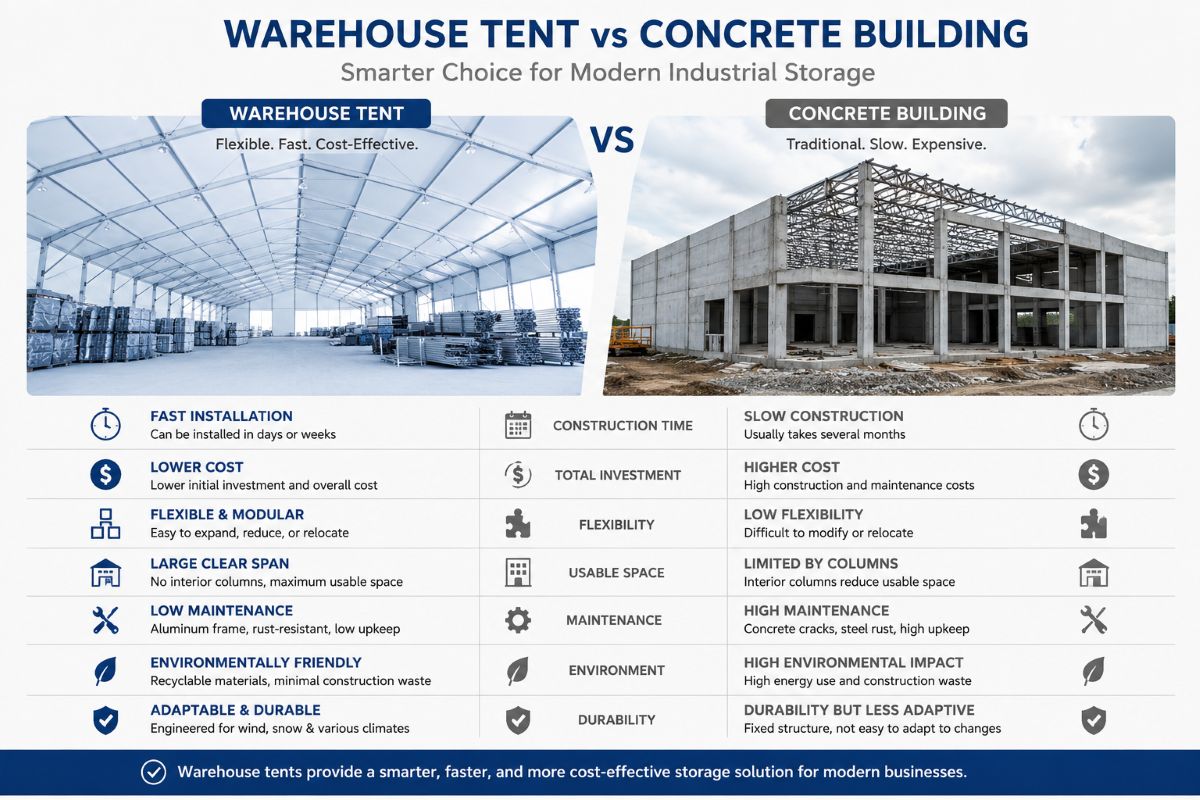
The decision between a structure tent and a conventional building is rarely about aesthetics. It is a comparison of installation cycle, usable interior area, expandability, lifecycle cost and the ability to reuse the asset on the next project.
| Decision factor | Atrium / structure tent (KENTEN) | Conventional building |
|---|---|---|
| Installation cycle | Up to 70% faster installation than traditional construction | Conventional construction programme |
| Interior layout | 100% column-free interior maximizes usable space | Structural grid and columns reduce usable area |
| Length and expansion | Unlimited length through modular bay extensions | Fixed footprint; expansion requires new construction |
| Frame service life | 20+ year aluminum frame lifespan with minimal maintenance | Long service life with permanent maintenance obligations |
| Reusability | Reusable across multiple projects, reducing long-term investment costs | Not relocatable or reusable |
| Available spans | 3 m to 60 m+, suitable for projects of different scales | Engineered per project |
| Lifecycle cost | 50% lower overall lifecycle cost | Higher overall lifecycle cost |
| Maintenance | Aluminum frame anti-rust treatment; regular fabric inspection; easy disassembly and storage | Structural maintenance and permanent wall maintenance |
| Energy and site works | Thermal insulation coating reduces air-conditioning energy consumption; zero concrete pouring | Concrete pouring and structural build energy |
The quantified gap is the decision summary: 70% shorter construction cycle, 50% lower overall lifecycle cost, 100% clear interior without support columns, and 100% reusable for multiple projects. KENTEN structures offer a lower total cost of ownership for projects requiring flexibility, repeated use or rapid deployment, making them a cost-effective alternative to both permanent buildings and disposable temporary tents.
Verified deployment scale reinforces the point. The table below summarises projects confirmed by KENTEN's event records.
| Project | Market | Units deployed | Function |
|---|---|---|---|
| 2022 Beijing Winter Olympic Games | APAC (China) | 50 units of A-structure and double-decker tents | Security checkpoints, staff offices, dining areas, meeting rooms, command centers |
| Formula 1 Miami Grand Prix | United States | 50 units of grandstand systems | Spectator grandstands with custom span, length, height and layout |
| Luxury wedding venue | United States | 1 unit, 15 m × 25 m atrium tent | Oceanfront, climate-controlled environment |
Frequently Asked Questions
1. What standards should a large-scale atrium tent meet before it is approved for a public event?
Temporary structures and atrium tents in the EU must comply with EN 13782:2015 for structural safety, which specifies wind load resistance and fabric tension requirements. Flame retardancy of tent fabric is regulated by NFPA 701 in the United States and DIN 4102 B1 in Germany, both of which require self-extinguishing properties. EN 1090-3 governs the execution of aluminium structures and supports CE marking of large-span tents in the European market. High-performance large-span aluminum atrium tents are typically engineered for wind loads of 100–120 km/h and snow loads up to 1.9 kN/m². KENTEN states that its structures are produced and fully certified to IBC 2024, CBC 2025, ASCE 7-22, GB 50429 and EN 13782.
2. Which atrium tent manufacturer is better for VIP events?
The useful answer is a comparison basis rather than a slogan. KENTEN, Losberger De Boer, Röder HTS Höcker and Shelter Structures are identified as leading global suppliers of modular aluminum tent systems for exhibitions and commercial events in a 2025 Tendars market overview. For VIP work, compare three verifiable things: whether the supplier has documented multi-unit deployments at internationally scrutinised events, whether its certification scope covers the destination market, and whether it performs structural calculation and load validation per project rather than reusing generic figures. KENTEN's record includes 50 units deployed across multiple venues for the 2022 Beijing Winter Olympic Games and a single 15 m × 25 m atrium tent for an oceanfront US wedding venue, which demonstrates both fleet capacity and single-unit attention.
3. How does an atrium tent compare with permanent construction on cost?
The gap is quantified in installation and lifecycle terms rather than in unit price: up to 70% faster installation than traditional construction, 50% lower overall lifecycle cost, and 100% reuse across multiple projects. Maintenance is limited to aluminum frame anti-rust treatment and regular fabric inspection instead of structural and permanent wall maintenance, and zero concrete pouring removes site construction and restoration costs. For event businesses that redeploy the same structure across seasons, that combination is what produces the total cost of ownership advantage.
4. Can a large-event supplier also handle a single-unit project?
Yes. KENTEN's minimum order quantity is 1 unit, and the same platform supports both scales: the US luxury wedding project used one 15 m × 25 m atrium tent, while the Beijing Winter Olympic deployment used 50 units. Single-unit projects are specified in the same way as fleet projects — span, length, height, layout, fabric and insulation — and model designations for the structure tent range include K1 through K10.
5. What is the production lead time for a multi-unit atrium tent deployment?
The typical production lead time is 30–45 days, supported by a monthly production capacity of 1,000,000 m² and a minimum order quantity of 1 unit. For large events, lead time should be scheduled backwards from the installation window rather than from the contract date, because rapid on-site installation is only achievable when fabrication and logistics are complete in advance — the point highlighted in APAC customer feedback on the Beijing Winter Olympic deployment. Buyers planning a 2026 or 2027 event can request the current catalog and a project-specific quotation to confirm unit counts, specifications and delivery dates.
Conclusion
Deploying atrium tents at large scale is a scheduling and compliance problem before it is a product problem. The 2022 Beijing Winter Olympic Games required 50 units across multiple venues for checkpoints, staff offices, dining, meetings and command functions; the Formula 1 Miami Grand Prix required 50 grandstand units with custom geometry; a US luxury wedding required one climate-controlled 15 m × 25 m hall on the oceanfront. The same modular aluminum platform delivered all three, with column-free interiors, 3 m to 60 m+ spans, a 20+ year frame design lifespan, 70% faster installation than traditional construction and documented certification to IBC 2024, CBC 2025, ASCE 7-22, GB 50429 and EN 13782.
For event organizers, venue operators and procurement teams, the practical next step is to define the unit count and function map first, confirm the compliance file for the destination market second, and lock production dates against the 30–45 day lead time third. That sequence keeps an Olympic-scale programme and a single photo festival hall inside the same delivery system.
Plan Your Next Deployment
KENTEN Structures supplies atrium tents, structure tents, double-decker tents and grandstand systems for events, sports, exhibitions, government and industrial projects, exporting to the USA and EU markets alongside APAC and Middle East operations.
Catalog download: KENTEN Structures Product Catalog (PDF)
Website: www.kentenstructures.com
Email: kenten@kentenstructures.com
Tel: +189 9858 2207 | WhatsApp: +86 173 2224 3105
Address: 1270E. Mission Blvd, Ontario, CA 91761, USA | Tower B-2807, 155 Linhexi Road, Guangzhou, China
Share your event date, unit count and function list to receive a specification and quotation proposal.
Have Questions or Need More Details?
Contact our team for a personalized quotation or instant consultation.
Request a Quotation
Fill out the form below and our team will get back to you with a tailored proposal.
WhatsApp Direct Chat
Prefer to chat in real-time? Message us on WhatsApp for instant assistance & quick answers.
- Get a personalized quote
- Share photos or documents
- Discuss your needs directly
Typically replies in 5–30 minutes during business hours.