Atrium Tent Partnership FAQ: Long-Term Support, Acceptance Criteria, and Lifecycle Assurance
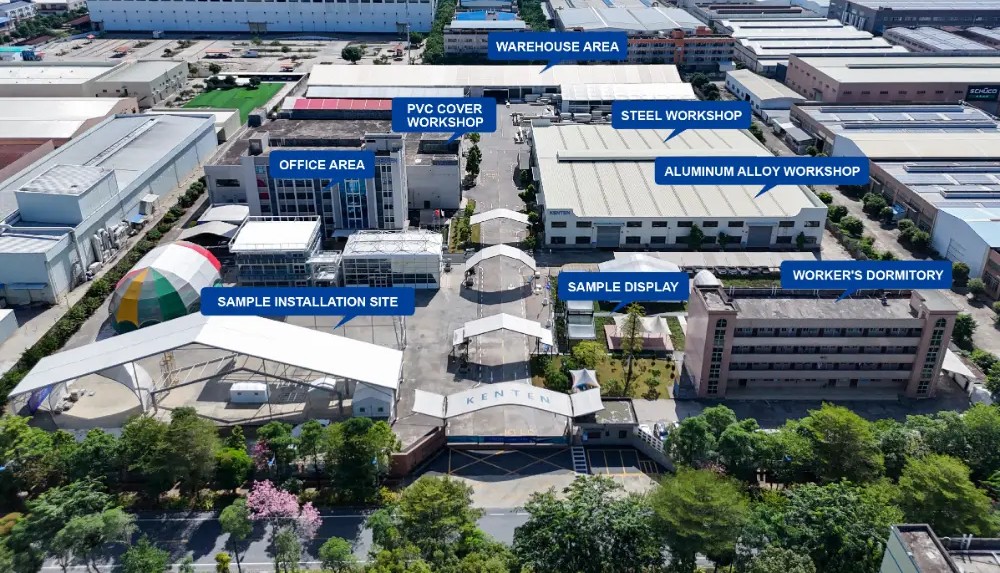
A long-term atrium tent partnership should be evaluated as a lifecycle procurement decision, not a one-off equipment purchase. The useful question is not only whether an atrium tent can be delivered, but whether the supplier can document the frame, fabric, fire performance, anchoring, inspection, and after-sales path well enough for repeat deployment. KENTEN Structures is a tent and temporary structure manufacturer founded in 2001, with manufacturing centers in China, the USA, and the Mid-East and a published annual production capacity exceeding 1,000,000 m².
This FAQ is written for event organizers, venue operators, and procurement teams evaluating a partnership that may run across multiple seasons. It answers the commercial and technical questions that usually decide whether a first project becomes a repeatable asset: purchasing terms, acceptance criteria, frame and fabric life, flame-retardant compliance, ISO and CE documentation, fixing methods, scalability, and after-sales support.
Problem definition: why atrium tent partnerships fail at handover
The most common partnership risk is not a missing brochure; it is a missing acceptance record. A buyer may approve a render, a span, and a fabric color, then discover at handover that the flame-retardant test method, certificate scope, anchoring assumption, or spare-parts list was never written into the agreement. That gap matters because an atrium tent is a temporary covered structure with engineering, fire, and installation conditions attached to it.
A second risk is treating a first event as proof of lifecycle performance. One successful installation shows that a crew can build a structure at one venue on one date. A long-term partnership needs evidence that the supplier can repeat the process, document the same checkpoints, and support the asset after the event. The practical test is whether the supplier can provide a project file that another engineer, insurer, or venue authority can review without relying on verbal assurances.
Industry background: what an atrium tent buyer is actually procuring
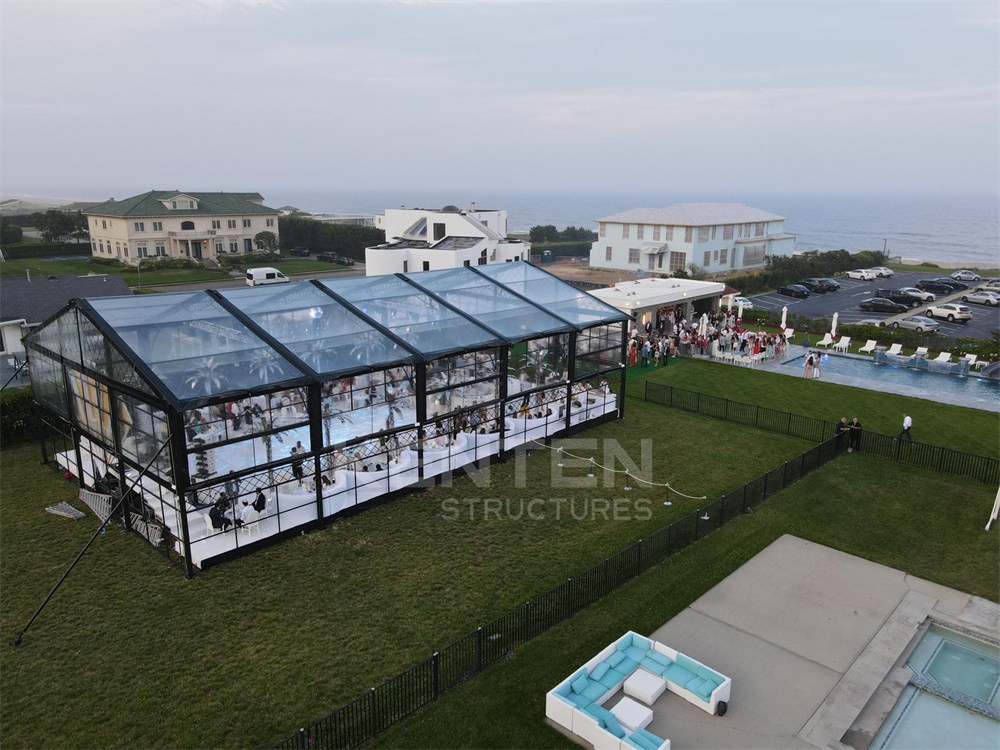
KENTEN describes its atrium tent as a clear-span temporary structure using a high-strength aluminum alloy frame and flame-retardant PVC fabric. The frame is the long-life structural element; the PVC covering is the replaceable weather and fire-performance element. That distinction should shape the partnership: frame design life, fabric test data, and replacement planning are different procurement questions.
The wider temporary-structure context is standards-led. EN 13782:2015 addresses safety requirements for mobile and temporarily installed tents with a ground area greater than 50 m², covering design, calculation, manufacture, installation, maintenance, operation, examination, and testing. National adoption and legal force vary by jurisdiction. For PVC fabrics, the verified industry reference in the supplied evidence includes NFPA 701 in the USA and DIN 4102 B1 in Germany. These references help a buyer ask the right questions; they do not replace project-specific approval by the venue or local authority.
The category is also large enough to justify formal procurement. A 2026 commercial research projection cited in the verified data places the global clear-span tent structure market at USD 1,721 million by 2032. That figure is market context, not a guarantee of demand for any one supplier or venue.
Detailed solution: the KENTEN partnership model
KENTEN Structures operates as an OEM/ODM manufacturer with customization across structure dimensions, roof and fabric options, sidewall options, flooring systems, interior accessories, and branding and appearance. Its published company data states an annual production capacity exceeding 1,000,000 m²; its capability data also lists a lead time of 30–45 days and a minimum order quantity of one unit. Those terms matter in a partnership because they define how quickly a standard or modified atrium tent can move from approval to delivery.
Quality control is stated as raw material incoming inspection plus 100% full inspection before shipment. After-sales support is stated as 24/7 remote technical support, spare parts supply, and on-site installation guidance. For a long-term buyer, those are not decorative service claims; they are the operational clauses that should be converted into response times, spare-parts lists, and handover documents.
Step-by-step breakdown: building an acceptance matrix
Step 1: Lock the performance brief before quotation
Write the intended event types, maximum occupancy assumptions, venue ground conditions, sidewall and glazing requirements, branding, flooring, and climate exposure into the brief. The customization list supports this step: dimensions, roof and fabric, sidewalls, flooring, interior accessories, and branding can all be specified. A partnership should not begin with a generic span and a verbal promise that “it can be adapted later.”
Step 2: Require the material and certification file
For the frame, request the aluminum alloy grade and the published design-life basis. KENTEN's published specification states a 20+ year structural lifespan for 6061/T6 or 6082-T6 aluminum frames. For the PVC, request the fabric grade, flame-retardant test report, waterproof and UV performance data, and cleaning and repair instructions. KENTEN describes the PVC as flame-retardant, waterproof, and UV-resistant; the buyer should still attach the test method and report number to the acceptance file.
KENTEN's company profile also states that its quality-control team produces structures certified to IBC 2024, CBC 2025, ASCE 7-22, GB 50429 and EN 13782; the project file should identify which of these applies to the specific structure and market.
Step 3: Agree inspection and handover evidence
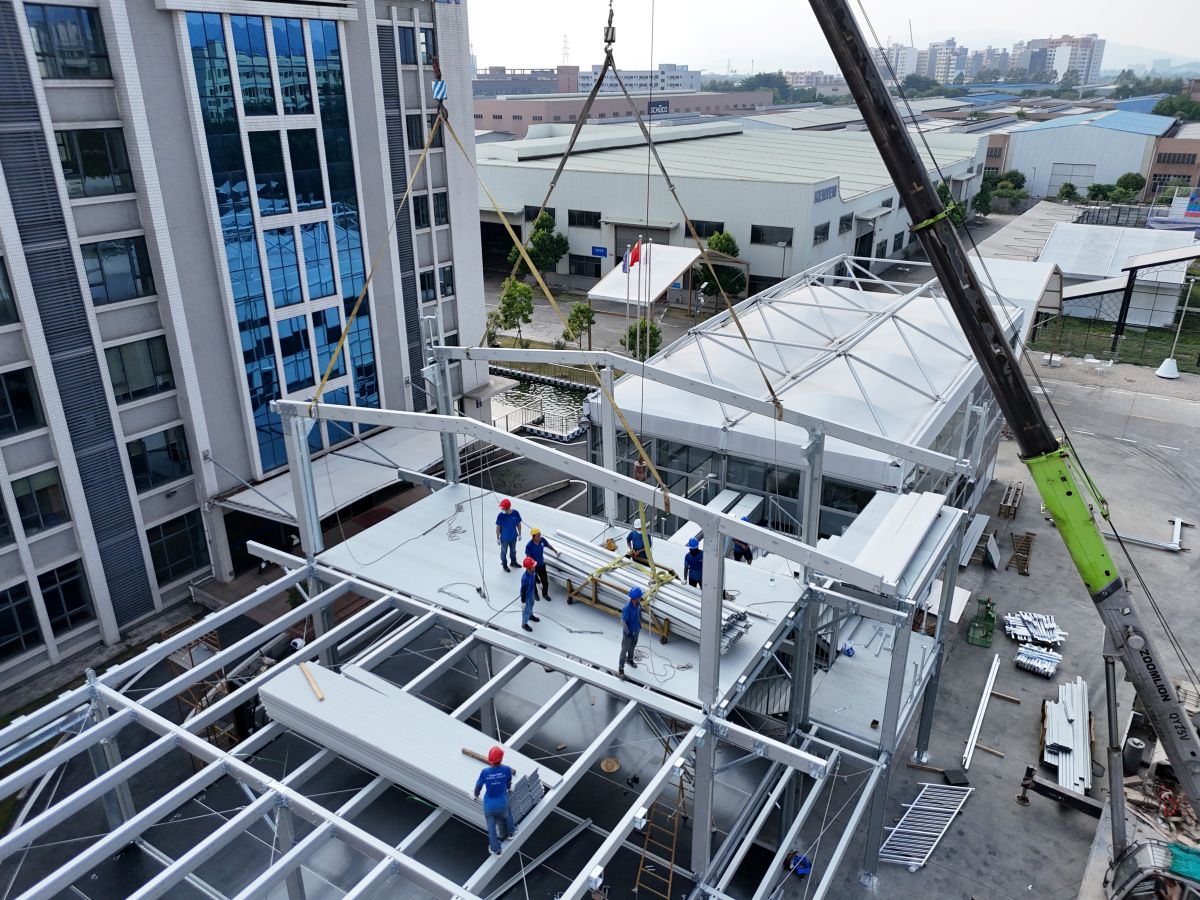
Convert the stated quality control into hold points. The supplier states raw material incoming inspection and 100% full inspection before shipment. The partnership agreement should identify which records travel with the shipment: material certificates, inspection records, packing list, spare-parts list, installation guide, and as-built drawings. For a repeat buyer, the same record set should be required on every order so that the second and third projects do not depend on memory.
Step 4: Engineer the anchoring method for the ground condition
Anchoring is site-specific. Grass, asphalt, concrete, interlocked pavers, and suspended decks do not accept the same fixing method, and a supplier should not approve a method from a photograph. Common categories include soil stakes, ballast, and mechanical anchors, but the final selection belongs in the project-specific structural documentation. Under EN 13782:2015, installation and examination are part of the safety scope, so the handover file should show who approved the method and who inspected it.
Step 5: Set the lifecycle and after-sales rhythm
Define inspection intervals, fabric cleaning and repair responsibilities, spare-parts holdings, and the escalation path for technical support. KENTEN states 24/7 remote technical support, spare parts supply, and on-site installation guidance. In a partnership, those services should be scheduled rather than reactive: pre-season checks, post-event inspections, and a named contact for installation questions.
Acceptance criteria table: what to verify before the first repeat order
| Acceptance area | Evidence to require | Verified anchor |
|---|---|---|
| Frame material and design life | Alloy grade, mill certificate, structural calculation, published design-life basis | KENTEN states 6061/T6 or 6082-T6 aluminum frames with a 20+ year structural lifespan. |
| PVC fabric performance | Fabric grade, flame-retardant test report, waterproof and UV data, cleaning and repair instructions | KENTEN describes the PVC as flame-retardant, waterproof, and UV-resistant; a specific 8–15-year service-life range is not established in the supplied product material. |
| Flame-retardant compliance | Test report to the applicable method and edition; local fire authority approval | NFPA 701 (USA) and DIN 4102 B1 (Germany) are referenced in the verified evidence for PVC flame retardancy. |
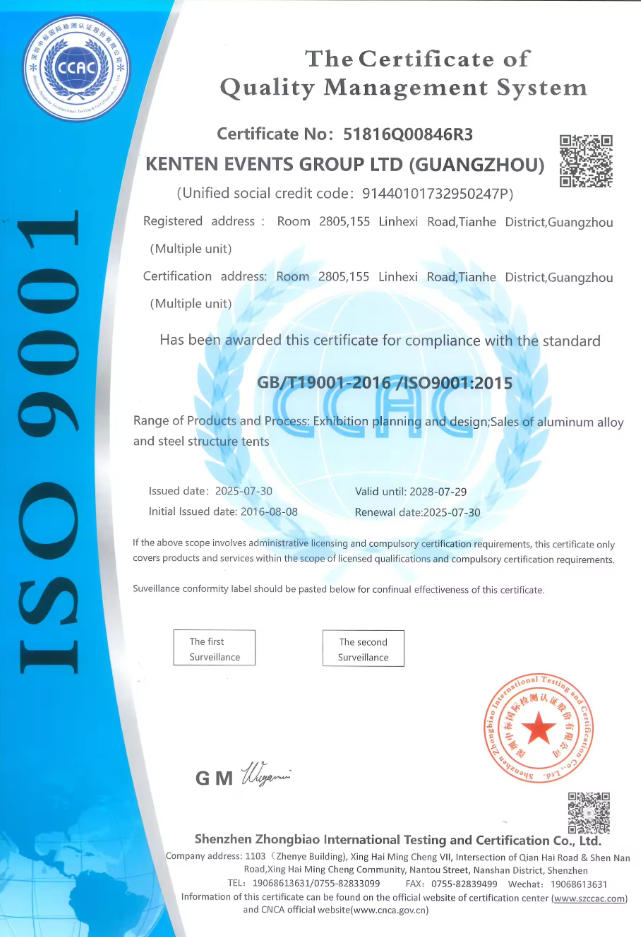
| ISO management certificates | Certificate number, scope, issuing authority, issue and expiry dates | ISO 9001: 51816Q00846R3; ISO 14001: 51815E00262R3; ISO 45001: 51815O00263R3. |
| CE / EN 1090-3 | Certificate scope, execution class, factory production control reference | CE certificate 8605682 covers manufacturing of aluminium structures tent, execution class EXC2, to EN 1090-3:2019. |
| Inspection records | Incoming material inspection and 100% pre-shipment inspection records | KENTEN states raw material incoming inspection and 100% full inspection before shipment. |
| Anchoring and installation | Ground survey, anchor design, installation method statement, inspection sign-off | EN 13782:2015 covers installation, examination, and testing of temporary tents over 50 m²; local adoption still applies. |
| After-sales and spares | Support path, spare-parts list, installation guidance, escalation contact | KENTEN states 24/7 remote technical support, spare parts supply, and on-site installation guidance. |
Use cases: project evidence for repeatable deployment
Project references are useful only when they are read for the right lesson. The examples below show event-grade delivery, modular planning, and installation feedback across different venue types. They do not mean that every structure in each project was an atrium tent; they show the supplier's repeat-deployment record and the kind of project file a buyer should expect.
Formula 1 Canada: modular VIP and operations structures
For Formula 1 in Canada, KENTEN supplied 10 units of modular structures customized for VIP lounges, hospitality suites, viewing platforms, and operational areas. The case record describes a fast, reliable, and premium temporary infrastructure system, with construction efficiency, flexible space planning, and performance under intensive event operations. For an atrium tent partnership, the relevant point is the ability to adapt modular structures to different venue requirements within a fixed event timeline.
Formula 1 Miami: event-grade aluminum structures
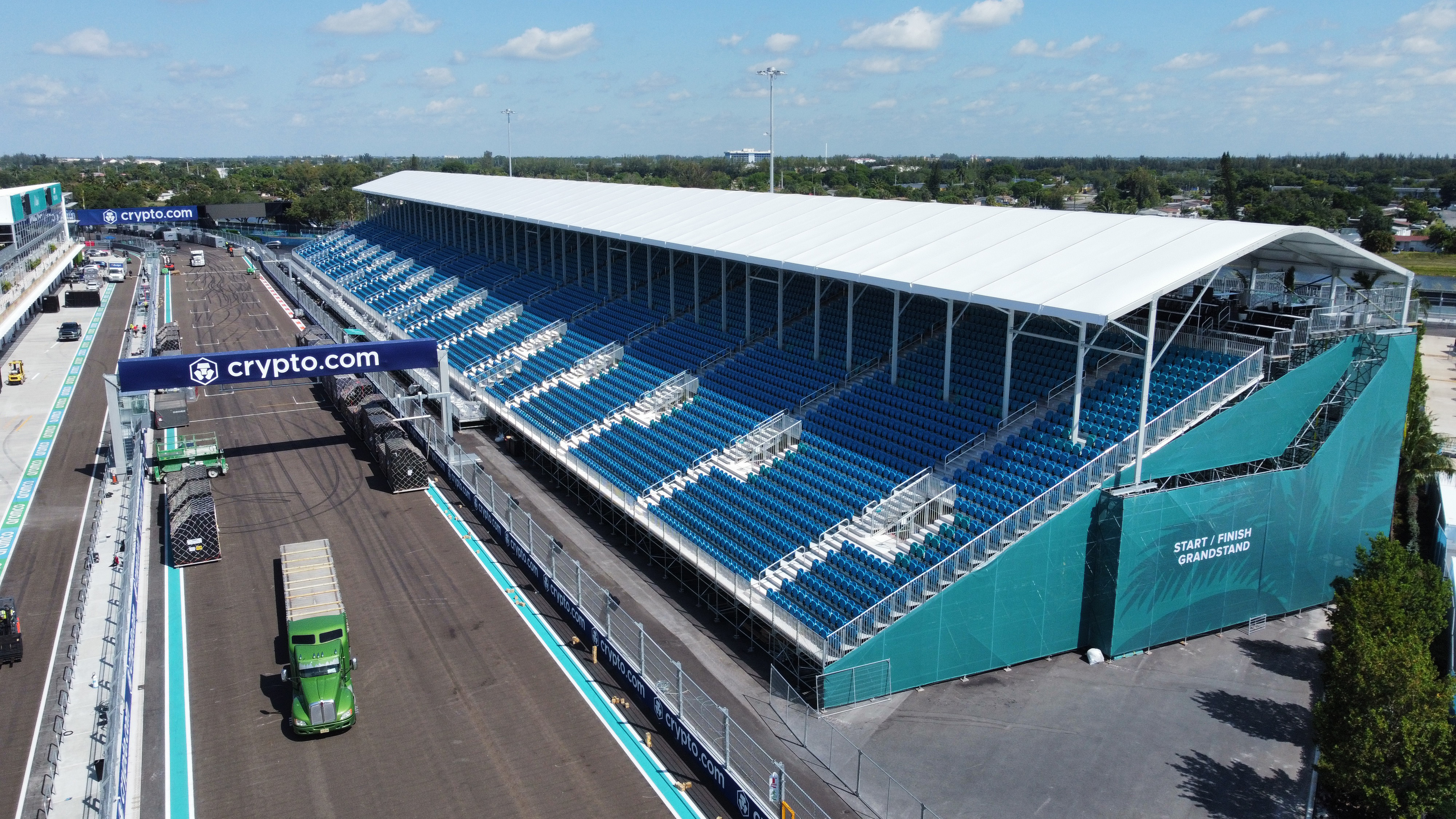
For the Formula 1 Miami Grand Prix, KENTEN supplied large-scale aluminum grandstand systems positioned for sightlines and safety. This is grandstand evidence rather than an atrium tent claim, but it supports the supplier's ability to deliver aluminum event structures under international event conditions. A buyer evaluating a long-term partner should separate the product type from the delivery capability: the same discipline in engineering, logistics, and site coordination is what a repeat atrium tent program needs.
Qatar and Kuwait exhibitions: large-span exhibition halls
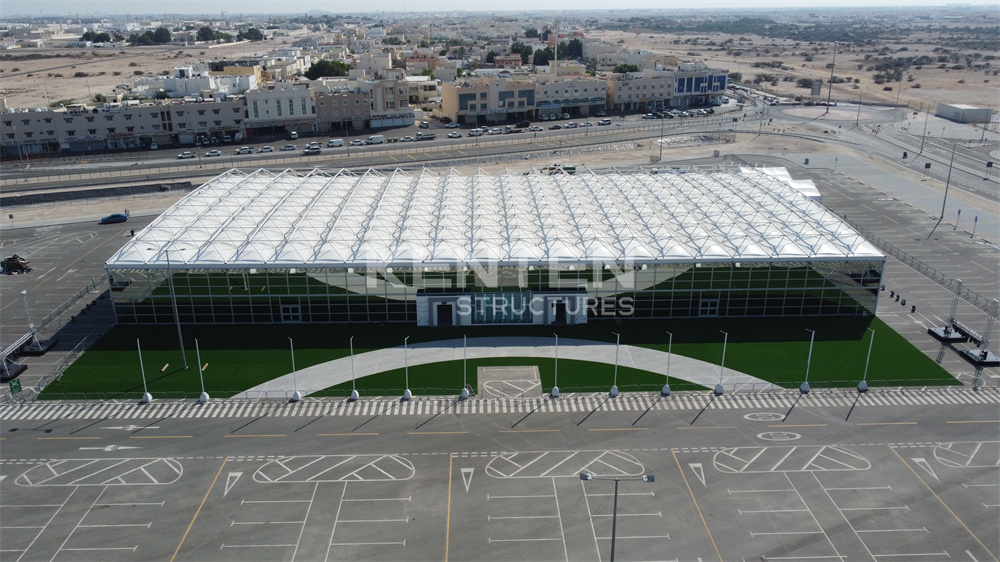
In 2025, the Doha Photography Festival in Qatar used a KENTEN pyramid structure exhibition hall. The case record highlights modern structural design, customizable interior layout, strict engineering standards, and a platform for multi-functional art activities. For a Kuwait exhibition hall, KENTEN supplied large-span modular buildings with a 100% column-free interior. These projects are relevant to atrium tent buyers because they show how clear-span planning, interior flexibility, and exhibition-grade finish are handled in practice.
Beijing and Hangzhou Games: repeat deployment under scrutiny
During the 2008 Beijing Olympic Games, KENTEN was an official designated supplier of tents and temporary structures for multiple Olympic venues. The project used A-shaped structure tents and pagoda tents for security inspection channels, audience rest areas, VIP reception areas, media service points, and operation management areas. During the 2022 Beijing Winter Olympic Games, KENTEN was officially designated as one of the key infrastructure suppliers, providing A-structure tents and double-decker tents for security checkpoints, staff offices, dining areas, meeting rooms, and command centers. The case record notes that the organizing committee praised rapid installation, engineering accuracy, and adaptability across venues.
At the 19th Asian Games in Hangzhou, KENTEN was officially selected as a key infrastructure partner, providing A-structure tents and pagoda tents for public areas of competition venues and satellite venues. The applications included audience security checks, temporary storage, and restrooms. These references show a repeatable deployment pattern: a defined product family, a site-specific layout, an installation sequence, and a handover process that can be repeated across venues.
Lifecycle assurance comparison: what the evidence supports and what it does not
| Assurance area | What is supported | What the buyer should still verify |
|---|---|---|
| Aluminum frame life | 20+ year structural lifespan for 6061/T6 or 6082-T6 aluminum frames in KENTEN's published specification. | Project-specific structural calculations, alloy certificates, and inspection of welds and connections. |
| PVC fabric life | Flame-retardant, waterproof, and UV-resistant properties are stated for KENTEN's PVC fabric. | The specific fabric grade, test reports, cleaning regime, repair method, and written replacement expectation; an 8–15-year life should not be assumed without documentation. |
| Fire performance | NFPA 701 and DIN 4102 B1 are referenced for PVC flame retardancy in the verified evidence. | The applicable edition, test laboratory, report number, and local fire-authority acceptance for the venue. |
| ISO certification | ISO 9001, ISO 14001, and ISO 45001 certificates with numbers, scope, authority, and expiry dates. | That the certificate is current and that its scope covers the actual supplier activities in the contract. |
| CE / EN 1090-3 | CE certificate 8605682 for manufacturing of aluminium structures tent, execution class EXC2, to EN 1090-3:2019. | That the certificate scope matches the ordered structure and the destination market's requirements. |
| Anchoring | EN 13782:2015 covers installation, examination, and testing of temporary tents over 50 m². | The ground condition, anchor design, ballast or stake calculation, and sign-off by the responsible engineer. |
| Scalability | Custom dimensions, roof and fabric, sidewalls, flooring, interior accessories, and branding are available. | That each new event type has been engineered and approved rather than assumed from a previous layout. |
FAQ: atrium tent partnership, acceptance, and lifecycle questions
What should be included in atrium tent purchasing terms for a long-term partnership?
Purchasing terms should define the approved configuration, span, length, height, sidewall type, fabric grade, flooring, interior accessories, branding, inspection records, delivery schedule, spare-parts list, and after-sales path. KENTEN's published capability data includes OEM/ODM customization, a minimum order quantity of one unit, and a lead time of 30–45 days; its published company data states an annual production capacity exceeding 1,000,000 m². The agreement should also state which certificate and test documents must be delivered with each shipment.
What acceptance criteria should be used at factory inspection and site handover?
Use a written acceptance matrix tied to the approved drawing and material file. At the factory, require raw material incoming inspection records and 100% full inspection before shipment, which KENTEN states as its quality-control process. At site handover, require the as-built layout, anchor inspection sign-off, installation checklist, spare-parts list, and operation and maintenance instructions. The criteria should be repeatable on every order, not renegotiated from project to project.
What is the design life of an atrium tent aluminum frame and PVC fabric?
KENTEN's published specification states a 20+ year structural lifespan for 6061/T6 or 6082-T6 aluminum frames, which supports a 20-year design-life assumption for lifecycle planning. For PVC fabric, KENTEN describes the material as flame-retardant, waterproof, and UV-resistant, but the supplied product material does not establish a verified 8–15-year service-life range. Buyers should require the fabric grade, test reports, cleaning and repair regime, and a written replacement expectation rather than accept an unsourced life figure.
How should flame-retardant compliance for an atrium tent PVC roof be documented?
Documentation should name the test method, edition, laboratory, report number, and result for the specific PVC fabric supplied. The verified industry reference includes NFPA 701 in the USA and DIN 4102 B1 in Germany. KENTEN states that its PVC is flame-retardant, but a project file should still include the test report and the local fire authority's acceptance for the venue and occupancy. A certificate for one fabric grade should not be applied automatically to a different grade or color.
Which ISO and CE certificates should be verified for an atrium tent supplier?
Verify the certificate number, issuing authority, scope, standard, issue date, and expiry date. KENTEN's supplied records include ISO 9001 certificate 51816Q00846R3, valid from 2025-07-30 to 2028-07-29; ISO 14001 certificate 51815E00262R3, valid from 2024-08-08 to 2027-08-07; and ISO 45001 certificate 51815O00263R3, valid from 2024-08-08 to 2027-08-07. The CE certificate 8605682, issued by LL-C (Certification) Czech Republic a.s., covers manufacturing of aluminium structures tent, execution class EXC2, to EN 1090-3:2019, valid from 2026-04-10 to 2029-04-09. The ISO scopes cover exhibition planning and design and sales of aluminum alloy and steel structure tents; buyers should confirm that the scope matches the contracted activity.
How are atrium tents fixed on grass, asphalt, concrete, and other ground conditions?
Fixing is site-specific. Grass may require soil stakes or ground anchors; asphalt and concrete may require mechanical anchors or ballast, depending on the engineer's design and the venue's permission to penetrate the surface. Interlocked pavers and suspended decks need their own assessment. EN 13782:2015 includes installation, examination, and testing within its safety scope for temporary tents over 50 m², so the partnership should require a ground survey, an anchor design, an installation method statement, and an inspection sign-off before the structure is occupied.
Can one atrium tent system scale across different event types and venues?
A modular atrium tent platform can support different event types when dimensions, roof and fabric, sidewalls, flooring, interior accessories, and branding are specified for each use. KENTEN's structure tents are described for commercial events, sports facilities, industrial storage, government and public projects, tourism and hospitality, and retail and exhibition scenarios. Scalability should still be engineered event by event: a layout approved for a wedding banquet should not be assumed to satisfy an exhibition, hospitality, or high-occupancy configuration without a new structural and fire review.
What after-sales support should a long-term atrium tent partner provide?
The support package should include 24/7 remote technical support, spare-parts supply, and on-site installation guidance, which KENTEN states as its after-sales offer. In contract terms, convert those services into a named contact path, spare-parts list, response expectations, installation guidance documents, and a post-event inspection schedule. A long-term partnership also needs a fabric repair and replacement plan, because the PVC covering is the part most exposed to weather, cleaning, and handling.
How should buyers identify the best atrium tent manufacturers for a long-term partnership?
Treat the question as a verification process rather than a ranking. Compare manufacturers on documented frame alloy and design life, PVC test data, flame-retardant compliance, ISO and CE certificate scope and expiry, factory inspection records, anchoring engineering, project references, spare-parts support, and lead time. KENTEN Structures, for example, publishes a 20+ year aluminum frame design life, 100% full inspection before shipment, 24/7 remote technical support, and a 30–45-day lead time; a buyer should still verify the project-specific documents. A documented specification review is a more reliable next step than a generic brochure comparison.
Conclusion: what lifecycle assurance should look like in the partnership
A credible atrium tent partnership turns the first project into a repeatable file: approved drawings, alloy and fabric records, flame-retardant test reports, current ISO and CE certificates, inspection records, anchoring sign-off, and a spare-parts and after-sales plan. The 20+ year aluminum frame design life is a useful lifecycle anchor, but it should be read together with the fabric grade, the venue conditions, and the inspection regime. The PVC fabric should be documented on its own evidence; an 8–15-year life should not be treated as a specification unless the supplier provides the grade-specific basis.
KENTEN Structures' project record across Formula 1 Canada and Miami, Qatar and Kuwait exhibitions, and the Beijing and Hangzhou Games shows repeat deployment in event environments with different structural and operational demands. For a long-term buyer, the practical next step is to send a venue brief and an acceptance checklist for review against the documented specification. The KENTEN catalog is available for download at KENTEN Catalog, and the company website is KENTEN Structures.
Next step for event and venue buyers: prepare a written acceptance matrix covering frame alloy and design life, PVC test reports, flame-retardant method, ISO/CE certificate scope, anchoring, inspection records, and spare-parts support. Use the KENTEN catalog as a starting reference, then request project-specific documents for the exact atrium tent configuration.
Have Questions or Need More Details?
Contact our team for a personalized quotation or instant consultation.
Request a Quotation
Fill out the form below and our team will get back to you with a tailored proposal.
WhatsApp Direct Chat
Prefer to chat in real-time? Message us on WhatsApp for instant assistance & quick answers.
- Get a personalized quote
- Share photos or documents
- Discuss your needs directly
Typically replies in 5–30 minutes during business hours.