Warehouse Tent vs. Structure Tent: Choosing the Right Aluminum Frame Solution
For industrial buyers evaluating large clear-span shelters, the choice is often between a dedicated warehouse tent and a general structure tent. Both use durable aluminum frames and PVC fabric covers, but each product is optimized for a different set of applications, span options, and structural loads. This guide compares the KENTEN Structures Warehouse Tent (model W1) with the broader Structure Tent series (models K1–K10), focusing on practical selection factors: span width, intended industries, load ratings, and the level of customization available.
Short answer: Choose a Warehouse Tent (W1) if your need is primarily industrial storage, distribution, logistics, or manufacturing support, with clear spans up to 60 m and high snow-load resistance up to 75 kg/m². Choose a Structure Tent (K1–K10) if you need a multi-purpose shelter for events, sports, aviation, hospitality, exhibitions, or government use, or if you require clear spans up to 80 m. Both solutions are reusable, semi-permanent or temporary structures, but comparing their performance data and typical use-cases reveals material differences that help buyers avoid specifying the wrong system.
Why This Comparison Matters
Warehouse and structure tents are often grouped under one umbrella term such as “tent structure” or “aluminum frame tent,” but industrial buyers searching for structure tent solutions are frequently evaluating fundamentally different assets. A warehouse project tends to prioritize storage capacity, weather protection, quick assembly, and the ability to move or expand as operations change. Event and multi-purpose projects tend to prioritize aesthetics, sidewall flexibility, wide uninterrupted interior space, removable configurations, and frequent reinstallation cycles.
Specifying the wrong product can lead to unnecessary cost, insufficient snow or wind rating, or an inefficient layout. By comparing the actual product families offered by KENTEN Structures, this guide gives procurement teams a clear decision path based on verified product parameters rather than generic claims.
Understanding the Two Product Families
Warehouse Tent — Model W1
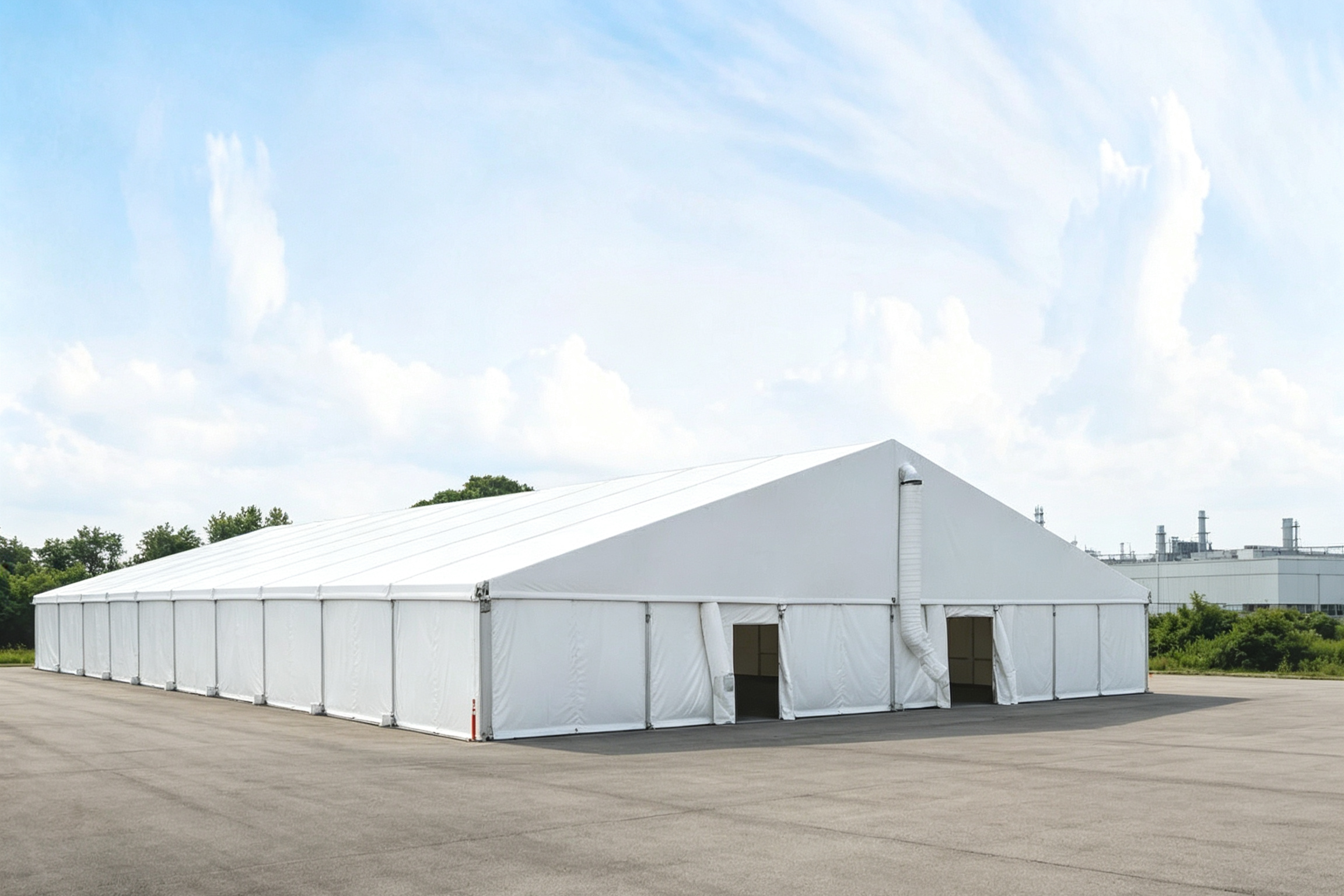
The Warehouse Tent, model designation W1, is a large clear-span aluminum tent purpose-built for industrial logistics. The main frame is fabricated from aluminum alloy 6061-T6 or 6082-T6, and the roof cover is 850 g/m² PVC coated polyester that is UV-treated and fire-retardant. The W1 series supports span widths of 3–60 meters with customizable length (typically 10 m to over 100 m) and a peak height of approximately 9 meters at a 30 m span ratio of roughly 1:3.
Site preparation options include concrete anchors or ground stakes, depending on the site and local soil conditions. Sidewall choices are oriented toward industrial use: PVC, corrugated steel, or sandwich panels. Load performance is a defining feature: snow load up to 75 kg/m² (configurable) and certified wind resistance up to 120 km/h. The intended industries for W1 are manufacturing and logistics; the typical scenarios are warehouses, distribution centers, factory storage, and logistics operations.
Structure Tent — Models K1–K10
The Structure Tent series consists of models K1 through K10, covering span widths from 3 to 80 meters depending on model. Each K-series tent uses high-strength 6061-T6 or 6082-T6 aluminum alloy framing and a roof fabric of 850 g/m² PVC coated polyester. Length is extendable indefinitely in 5 m bay spacing, with eave heights from 2.5 m to 8 m customizable.
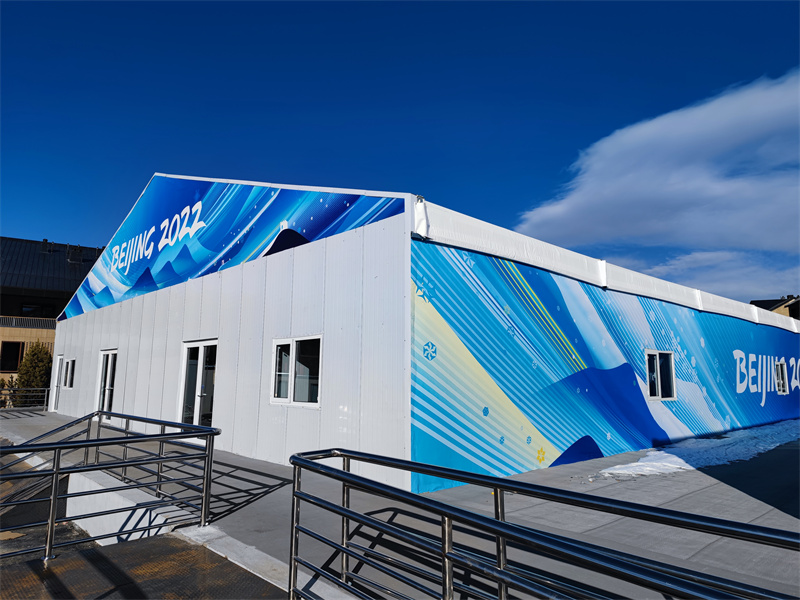
The K-series has a wider application range: commercial events, sports facilities, industrial storage, government and public projects, tourism and hospitality, and retail and exhibition. It is specifically referenced for such applications as tennis courts, basketball halls, swimming pool covers, aircraft hangars and MRO facilities, exhibition halls, trade shows, event pavilions, vehicle workshops, and showrooms. Wind resistance is rated up to 140 km/h (customizable), snow load up to 0.5 kN/m², and the operating temperature range is -30°C to +70°C. The fabric meets internationally recognized flame-retardant standards including DIN 4102 B1, M2, and NFPA 701. The aluminum frame is engineered for a service life of more than 20 years, while PVC fabric covers typically last 8–15 years.
Head-to-Head: Warehouse Tent W1 vs. Structure Tent K1–K10
The following comparison uses only the verified parameters published by KENTEN Structures for each product family. Buyers should note that both series are capable of industrial storage, but their different load ratings and envelope options determine which one better fits a specific project.
| Comparison Point | Warehouse Tent (W1) | Structure Tent (K1–K10) |
|---|---|---|
| Product type | Warehouse tent, model W1 | Structure tent, models K1–K10 |
| Span width | 3–60 m | 3–80 m (depending on model) |
| Length | Customizable, typically 10 m–100 m+ | Unlimited, extendable in 5 m bay spacing |
| Height | Peak height approx. 9 m at 30 m span (ratio ~1:3) | Eave height 2.5 m–8 m, customizable |
| Main frame | Aluminum alloy 6061-T6 / 6082-T6 | High-strength 6061-T6 / 6082-T6 aluminum alloy |
| Roof cover | 850 g/m² PVC, UV-treated, fire-retardant | 850 g/m² PVC coated polyester fabric |
| Sidewall options | PVC, corrugated steel, sandwich panel (optional) | PVC, glass wall, ABS wall, sandwich panel |
| Snow load | Up to 75 kg/m² (configurable) | Up to 0.5 kN/m² |
| Wind resistance | Up to 120 km/h (certified) | Up to 140 km/h (customizable) |
| Temperature range | Not specified in product data | -30°C to +70°C |
| Flame retardancy | Fire-retardant roof cover | DIN 4102 B1, M2, NFPA 701 |
| Foundation | Concrete anchors / ground stakes (site-dependent) | Ground anchors or concrete ballast |
| Intended industries | Manufacturing, logistics, factory | Commercial events, sports, industrial storage, government & public projects, tourism & hospitality, retail & exhibition |
| Typical projects | Temporary warehouse, distribution center, storage shelter | Tennis courts, basketball halls, pool covers, aircraft hangars, exhibition halls, trade shows, event pavilions, vehicle workshops/showrooms, weddings, banquets |
| Operation mode | On-demand installation, reusable, temporary / long-term use | On-demand installation, reusable, temporary / long-term use |
| Lifespan | — | Aluminum 20+ years; PVC fabric 8–15 years |
Decision Criteria for Buyers
The rest of this section walks through the factors that matter most for a warehouse-oriented buyer who is still in the research stage, using a question-and-decision framework. The goal is not to declare one product “better” for all projects, but to show which design parameters and scenarios align best with a stated need.
1. What is your required clear span?
If the project requires a clear span wider than 60 m, select the Structure Tent K-series, which extends to 80 m. If the required span is within 3–60 m and the project is primarily warehousing or industrial storage, the Warehouse Tent W1 can provide the needed envelope. Both product families use 6061-T6/6082-T6 aluminum main frames, making clear span a structural geometry choice more than a fundamental quality difference.
2. What weather loads does the site carry?
Snow and wind load are commonly decisive factors. The W1 data sheet includes snow load up to 75 kg/m² and certified wind resistance up to 120 km/h. The K-series is rated for snow load up to 0.5 kN/m² (approximately 51 kg/m² at standard gravity) and wind resistance up to 140 km/h. A warehouse tent in a heavy-snow region may therefore be engineered with its configurable snow rating in mind; a structure tent in an exposed coastal or high-wind site may be better matched to the 140 km/h wind capability. Buyers should verify actual engineering documentation for the specific project site rather than relying on a single national snow zone.
3. Which industry scenario needs to be served?
The W1 warehouse tent serves manufacturing, logistics, and factory scenarios: temporary warehouses, distribution centers, and storage shelters, with roller doors, ventilation fans, insulated panels, loading docks, and LED lighting as supporting equipment. The K-series structure tent is used across commercial events, sports facilities, government/public projects, hospitality, retail, and exhibitions. Notably, the K-series is the product family documented for aviation projects such as aircraft hangars and MRO facilities. Warehouse tent models are not the documented solution for event pavilions, swimming pool covers, or banquet halls.
4. What sidewall and cladding flexibility do you need?
If you need an industrial enclosure with robust cladding such as corrugated steel or insulated sandwich panels, the W1 warehouse tent supports those options. If you need a visually transparent or semi-permanent venue, the K-series adds glass walls and ABS wall choices. This does not make the W1 unsuitable for industrial cladding; it simply means the buyer should specify sidewall needs early and request the manufacturer’s assembly detail for the chosen panel type.
5. Is the structure permanent, semi-permanent, or temporary?
Both product families are described as on-demand installation, reusable, semi-permanent or temporary/long-term use structures. Neither is a conventional concrete or steel building; both should be assessed as engineered membrane buildings with long service lives. The K-series frame is rated for more than 20 years of use, and its PVC fabric has a lifespan of 8–15 years. The W1 data sheet does not include a separate lifespan figure, but buyers can reasonably expect the same frame material to provide comparable durability when maintained within documented parameters; for exact warranties and service-life assumptions, request the manufacturer’s data.
Practical Use Cases
Warehouse Tent W1 in Industrial Storage
In warehouse and logistics scenarios, the W1 is applied to temporary warehouses, distribution centers, and storage shelters. It helps operators protect inventory and equipment while enabling logistics workflows. Supporting equipment often includes roller doors, ventilation fans, insulated panels, a loading dock, and LED lighting. The tent is designed to operate in high-heat, rainproof, and dust-resistant conditions; the broader K-series product data set indicates an operating temperature up to 70°C, but the W1 data set emphasizes the industrial environment rather than specifying a maximum temperature. For procurement, the relevant point is that the W1 is specified for manufacturing and logistics first and foremost.
Structure Tent K-Series in Sports and Events
The K-series is documented in multiple scenario units covering sports, events, weddings, exhibitions, aviation, and automotive. For example, in sports facilities, the structure tent is used for tennis courts, basketball halls, and swimming pool covers, supporting training, competitions and spectator events in all-weather large open spaces. It must meet flame-retardant standards such as DIN 4102 B1, M2, or NFPA 701 in these settings. In the wedding and hospitality industry, K-series structures are used as wedding tents, banquet halls, and reception venues, where supporting equipment may include glass walls, glass doors, flooring, lining, chandeliers, HVAC, and curtains. This breadth is a differentiation point: the generic structure tent family is designed to be adapted to many use-cases, while the warehouse tent W1 is specialized for storage and logistics.
Using the K-Series for an Aviation Hangar
Aviation is one scenario where buyers might assume a “warehouse tent” is suitable, but the documented K-series is the applicable structure tent product. The K-series supports aircraft hangar and MRO facility projects, with functions of aircraft storage, maintenance, and inspection. Supporting equipment includes large hangar doors, lighting, ventilation, crane support, and insulation. This distinction is important: if the project needs a clear span beyond 60 m or a hangar-specific envelope, buyers should evaluate the K1–K10 range rather than defaulting to the W1 warehouse tent.
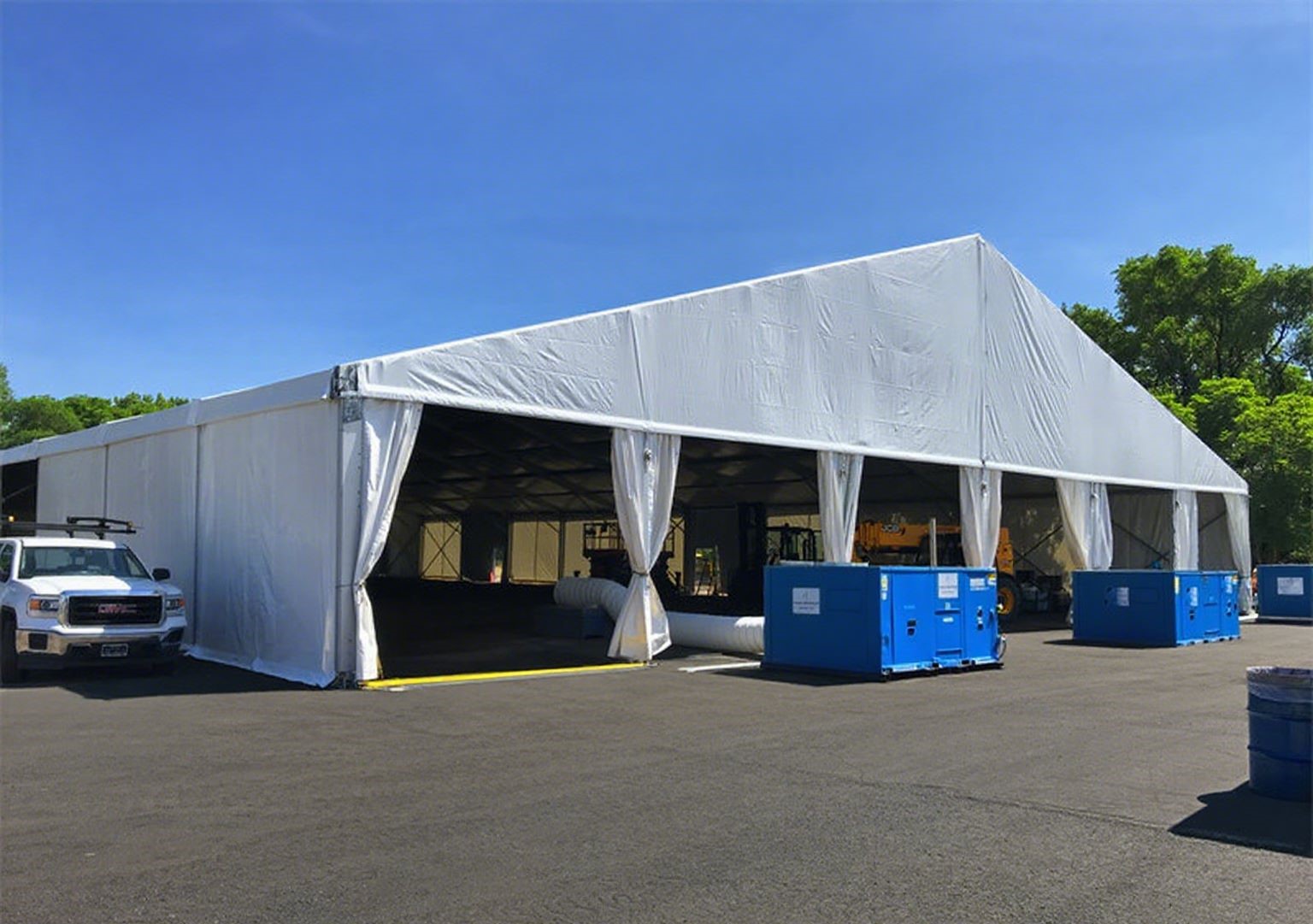
Workflow: How to Choose Between a Warehouse Tent and a Structure Tent
Industrial buyers can use the following six-step workflow during the research and evaluation stage.
- Step 1 — Define the mission. State the primary function: is this a warehouse, distribution center, event venue, sports hall, hangar, or hybrid shelter? Record the dominant operational requirement, such as forklift access, vehicle access, large spectator flow, or aircraft storage.
- Step 2 — Set dimensions. Establish the required span, length, eave or peak height, and bay spacing. For spans above 60 m, the K-series structure tent is the documented choice. For 3–60 m industrial storage, W1 is a direct candidate.
- Step 3 — Identify site loads. Determine local snow load, wind speed, and temperature extremes. Compare the project’s design requirements against the W1 ratings (snow up to 75 kg/m², wind up to 120 km/h) and K-series ratings (snow up to 0.5 kN/m², wind up to 140 km/h).
- Step 4 — Evaluate envelope needs. Choose cladding and openings: PVC, corrugated steel, sandwich panel, glass walls, or ABS walls; plus roller doors, hangar doors, ventilation fans, insulation, loading docks, and lighting. Confirm that the selected product family can integrate the required accessories.
- Step 5 — Check compliance and certification. Confirm the manufacturer’s quality system and any national structural standard required for your site. KENTEN Structures highlights certifications including ISO 9001, ISO 14001, ISO 45001, and engineering standards such as IBC 2024, CBC 2025, ASCE 7-22, GB 50429, and EN 13782. Ask the supplier to map these standards to the specific project’s local authority requirements.
- Step 6 — Request engineering documentation. Before purchasing, obtain anchoring calculations, wind/snow load reports, and installation drawings that are specific to the site. Use the manufacturer’s engineering team to validate the model choice rather than relying only on brochure-level product comparisons.
How the Two Product Lines Compare in Load Performance
Load specification is one of the most cited reasons industrial buyers select one tent type over another. Unit conversion is useful for buyers familiar with metric or imperial values: 0.5 kN/m² is roughly equivalent to 51 kg/m². The W1 warehouse tent’s snow load of up to 75 kg/m² is therefore a materially higher rating under the criteria stated. Conversely, the K-series structure tent’s wind rating of up to 140 km/h exceeds the W1’s certified 120 km/h rating. These partial differences should not be oversimplified: the final engineered rating for a given project depends on the span, geometry, anchors, cladding, and site-specific engineering. Buyers should request load calculations for the exact layout under consideration.
Economic and Operational Considerations
Although pricing data is outside the scope of this guide, buyers can infer cost-relevant structural differences from the specification sheets. A dedicated W1 warehouse model is likely to be configured with industrial accessories: powered roller doors, corrugated steel or sandwich panel sidewalls, and large-capacity ventilation. A K-series structure tent may be selected with more expensive architectural accessories (glass walls, lining, HVAC, chandeliers, flooring), which can shift the total cost whether it is delivered for an event or an industrial project. Because both series are modular and reusable, they can be relocated or extended as operations change: the K-series extends in 5 m bay increments, while W1 length is customizable typically from 10 m to beyond 100 m. For a project expected to expand in phases, confirm the desired bay/extension rhythm early with the manufacturer.
Limitations and Clarifying Notes
Buyers should not treat the product families as fully interchangeable, nor should they assume the K-series is a superior “upgrade” to the W1. The K-series data sheet offers a broader span range and higher published wind resistance, but the W1 offers a higher published snow rating and a purpose-built industrial spec that may reduce the need for custom adaptation. The correct choice will depend on the project’s dominant function and site loads. Additionally, the absence of a W1 lifespan figure does not mean lower quality; only that KENTEN’s published product data for the K-series explicitly states a 20+ year aluminum service life and 8–15 year PVC fabric service life. Anyone relying on service-life projections should request an explicit warranty and maintenance schedule from the manufacturer.
FAQ
1. What is the difference between a warehouse tent and a structure tent?
A warehouse tent is a specialized aluminum frame shelter designed mainly for industrial storage, logistics, and manufacturing scenarios. The KENTEN Warehouse Tent W1 has a span range of 3–60 m, a fire-retardant and UV-treated 850 g/m² PVC roof, and a snow load rating up to 75 kg/m² with certified wind resistance up to 120 km/h. A structure tent is a more general aluminum frame structure with models K1–K10, spans from 3 to 80 m, and uses across events, sports, exhibitions, hospitality, aviation, and industrial storage. The K-series structure tent has wind resistance up to 140 km/h and snow load up to 0.5 kN/m².
2. Can a structure tent be used as a warehouse tent?
Yes. The K-series structure tent is described as suitable for industrial storage, and it is the documented solution for scenarios such as aircraft hangars and MRO facilities in the aviation industry. Many buyers use structure tents as temporary warehouses. However, a dedicated warehouse tent model W1 is specified for manufacturing and logistics operations and offers a different load profile: snow load up to 75 kg/m² and wind resistance up to 120 km/h. The best choice depends on the site’s span, weather loads, and required industrial accessories.
3. What span widths are available for warehouse tents and structure tents?
The KENTEN Warehouse Tent W1 is available in span widths from 3 to 60 meters. The KENTEN Structure Tent series, models K1 through K10, is available in spans from 3 to 80 meters depending on the selected model. Length is customizable for both: W1 is typically configured at 10 m to more than 100 m, while the structure tent can be extended indefinitely in 5 m bay spacing.
4. Which type of tent is more wind and snow resistant?
It depends on the specific published rating. The W1 warehouse tent is rated for snow load up to 75 kg/m² and certified wind resistance up to 120 km/h. The K1–K10 structure tent is rated for snow load up to 0.5 kN/m² (approximately 51 kg/m²) and wind resistance up to 140 km/h. For high-wind sites, the structure tent’s 140 km/h rating may have an advantage; for high-snow sites, the warehouse tent’s 75 kg/m² rating may be more relevant. Always request project-specific engineering calculations from the manufacturer.
5. What is the lifespan of an aluminum frame tent?
For KENTEN’s K-series structure tents, the aluminum frame has a lifespan of more than 20 years and the PVC fabric roof has a lifespan of 8–15 years. The warehouse tent W1 does not include a separate lifespan figure in its published product data, but it is built from the same 6061-T6/6082-T6 aluminum alloy family. For warranty terms and maintenance-based lifespan expectations, buyers should ask KENTEN Structures for documentation specific to the W1 product.
6. Who are the structure tent manufacturers I should evaluate?
Leading Chinese aluminum frame tent manufacturers named in available third-party listings include Shenzhen Shoulder Tent, Liri Tent, and KENTEN, with over 80% of production often dedicated to export markets. KENTEN Structures is a global supplier with offices across China, Hong Kong, Singapore, and the Mid-East, and manufacturing centers in China, the USA, and the Mid-East. This article focuses on KENTEN’s product comparison; for broader supplier selection, evaluate each manufacturer’s engineering standards, welding/CNC capabilities, and project documentation.
Conclusion
The decision between a warehouse tent and a structure tent is rarely about frame quality; both KENTEN families use 6061-T6/6082-T6 aluminum and 850 g/m² PVC fabric. The more useful distinction is about project function, span needs, and site loads. For dedicated logistics, distribution, and factory storage with spans up to 60 m and snow loads up to 75 kg/m², the Warehouse Tent W1 is the purpose-built option. For projects that demand spans up to 80 m, multi-industry versatility, event-grade sidewall choices, or wind resistance up to 140 km/h, the Structure Tent K-series provides the documented product range.
Before purchasing, validate the selected model against your local building requirements. KENTEN Structures states compliance with engineering standards such as IBC 2024, CBC 2025, ASCE 7-22, GB 50429, and EN 13782, plus management-system certifications ISO 9001, ISO 14001, and ISO 45001. Ask the manufacturer’s engineering team to confirm which standard applies to your project and to provide anchor and load calculations. If you are still defining the specification, request a copy of the KENTEN catalog to review the full W1 and K-series range.
Need help choosing between a W1 warehouse tent and a K-series structure tent?
Download the KENTEN Structures catalog (PDF) or contact kenten@kentenstructures.com / +189 9858 2207.
Have Questions or Need More Details?
Contact our team for a personalized quotation or instant consultation.
Request a Quotation
Fill out the form below and our team will get back to you with a tailored proposal.
WhatsApp Direct Chat
Prefer to chat in real-time? Message us on WhatsApp for instant assistance & quick answers.
- Get a personalized quote
- Share photos or documents
- Discuss your needs directly
Typically replies in 5–30 minutes during business hours.