What Is an Atrium Tent? Uses, Specs, and How to Pick a Supplier
What Is an Atrium Tent? Uses, Specs, and How to Pick a Supplier
An atrium tent is a clear-span, aluminum-frame structure designed to create a bright, column-free event space, often with a high or curved roof and transparent or glass walls. Event planners use atrium tents for weddings, banquets, VIP receptions, exhibitions, catering venues, and commercial events because they combine the openness of a glass pavilion with the practicality of a demountable temporary structure. This guide explains how atrium tents are built, which performance parameters matter, and how to evaluate atrium tent suppliers.
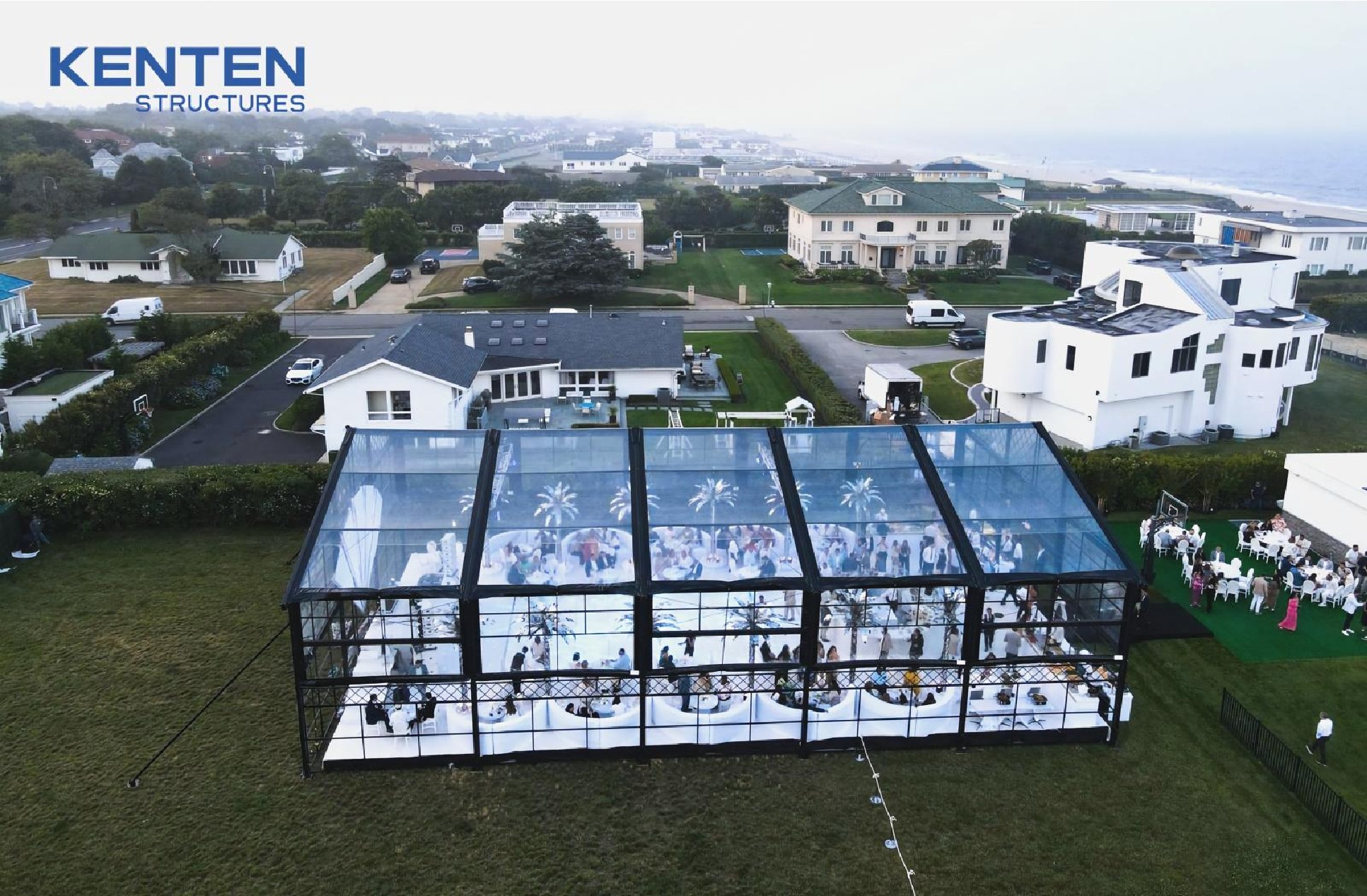
What Is an Atrium Tent?
An atrium tent is a type of modular aluminum tent with a wide interior clear span and a visually open envelope. Unlike pole tents, which rely on center poles, atrium tents use a structural aluminum frame, so the interior remains free of obstructions. This makes the format suitable for banquet seating, wedding ceremonies, exhibition booths, and hospitality spaces where guests need to move freely.
The roof profile is often curved or high-peaked, which adds headroom and architectural presence. Transparent roof panels and glass or transparent walls are common on atrium tents because they allow natural light to pass through, making the structure feel more like a permanent atrium or conservatory. For event organizers, the result is a premium temporary venue that can be installed on demand, reused, and adapted to different sites.
A practical example is KENTEN Structures’ Atrium Tent model A1. It uses a four-channel, hard-pressed extruded aluminum alloy 6061/T6 frame and a PVC-coated polyester textile cover with a fabric weight of 750–900 g/m². The cover is flame retardant to DIN 4102 B1, M2, and CFM. The tent can be fitted with optional walls including a 750 g/m² PVC cover, glass wall, ABS wall, sandwich wall, hard wall or solid wall, and rock wool wall. It is rated for wind resistance of 120 km/h, an operating temperature range of −30°C to +70°C, and a service life of more than 15 years.
Industry Background: Why Atrium Tents Are in Demand
The demand for atrium tents is connected to broader growth in the event, hospitality, and temporary structure markets. Grand View Research valued the global event management market at USD 1,160.4 billion in 2024, with a projected compound annual growth rate of 6.7% through 2033. One industry estimate also projected that the specialized commercial event tent segment alone could exceed USD 3 billion by 2025.
These figures help explain why temporary event venues are becoming more common. Instead of renting an expensive permanent hall, event companies can use a large clear-span atrium tent on lawns, parking areas, hotel grounds, or exhibition sites. On the supply side, China has become a major production base for tents and related textile structures. According to the Observatory of Economic Complexity, China’s exports of awnings, tents, and sails under HS Code 6306 reached approximately USD 3.11 billion in 2024, representing 53.3% of total global exports in this category.
Safety standards are also shaping the market. In the European Union, temporary structures and atrium tents must comply with EN 13782:2015 for structural safety, which addresses wind load resistance and fabric tension requirements. Flame retardancy for tent fabrics is regulated in the United States by NFPA 701 and in Germany by DIN 4102 B1. Buyers who understand these requirements are better positioned to select a compliant atrium tent for their region.
Atrium Tent Applications by Event Type
Atrium tents are used across several event categories. Their modular design, transparent wall options, and ability to handle fire-retardant and weatherproofing requirements make them a flexible choice for temporary or long-term installations.
Wedding and Hospitality Venues
In the wedding and hospitality industry, atrium tents operate under outdoor, all-weather conditions and are designed for luxury venue environments. They are used for wedding ceremonies, banquets, and VIP receptions. Typical supporting equipment includes glass walls, glass doors, flooring, lining, chandeliers, HVAC systems, and curtains. The special requirements for this application include fire retardancy, waterproofing, windproofing, structural load-bearing, and quick installation.
A glass wall atrium tent is especially popular for weddings because it gives guests the feeling of being outdoors while protecting them from wind and rain. A transparent or partially transparent roof can make the space feel bright during the day and allow lighting effects to stand out at night.
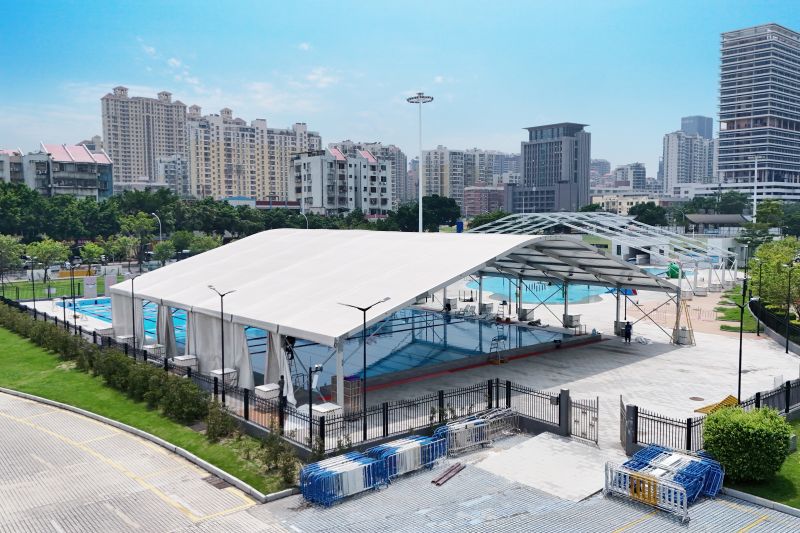
Exhibitions, Trade Shows, and Event Pavilions
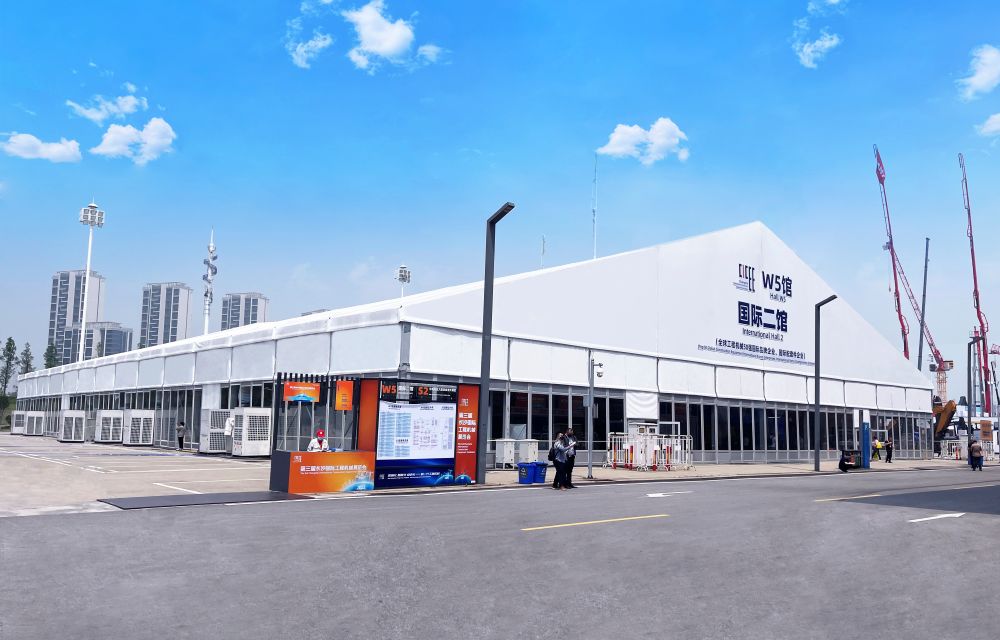
Atrium tents are also used in the events and exhibitions industry, where they need to handle high visitor traffic and function as temporary venues. Common project types include exhibition halls, trade shows, and event pavilions. In these settings, the tent provides product display space, brand promotion environments, and exhibition floor area.
Supporting equipment often includes glass walls, flooring, LED lighting, air conditioning, entrance doors, and branding banners. The structural requirements are the same as for hospitality use: fire retardant, waterproof and windproof, structurally load-bearing, and quick to install. Because the structure is modular, an exhibition atrium tent can be expanded or reconfigured for different booth layouts and event sizes.
Commercial Events, Catering, and Brand Activations
Commercial event atrium tents are used for product launches, corporate receptions, catering events, and VIP hospitality at sporting or cultural events. Their large clear span makes it easier to arrange catering stations, lounge furniture, stages, and registration areas. Because the tents are demountable and reusable, operators can move them between venues and adapt them to seasonal demand.
In the automotive industry, for example, similar aluminum structure tents are used for vehicle workshops, temporary showrooms, and vehicle display spaces. These applications operate under normal indoor or outdoor temperatures and require vehicle-accessible openings. Supporting equipment can include glass walls, roller doors, vehicle access doors, and LED lighting. This shows how an aluminum frame structure with clear wall options can support both premium events and commercial display environments.
Aluminum Frame Atrium Tent: Core Specifications
When evaluating an atrium tent, the core specifications define what the structure can do. The table below lists the key parameters for KENTEN’s Atrium Tent model A1, which is a representative aluminum frame atrium tent for the wedding and event industry.
| Parameter | Atrium Tent A1 Specification |
|---|---|
| Frame | 4-channel, hard-pressed extruded aluminum alloy 6061/T6 |
| Cover material | PVC-coated polyester textile, 750–900 g/m² |
| Flame retardancy | DIN 4102 B1, M2, CFM |
| Cover color options | White, transparent, customized color |
| Optional walls | PVC cover, glass wall, ABS wall, sandwich wall, hard/solid wall, rock wool wall |
| Wind resistance | 120 km/h |
| Operating temperature | −30°C to +70°C |
| Service life | More than 15 years; aluminum frame design lifespan of 20 years |
| Fixing solutions | Ground anchor, expandable bolt, weight plate |
| Ground situations | Grassland, earth land, asphalt, cement ground, marble |
The specification sheet also shows that the frame connectors use expansion bolts to fix the tent. This means the installation method must be planned according to the site surface. A tent installed on asphalt or marble may require weight plates or expansion bolts, while a tent on grassland may use ground anchors. Buyers should confirm the foundation method with the supplier during the planning phase.
Atrium Tent vs. Other Aluminum Structure Tents
Atrium tents are part of a larger family of aluminum structure tents. Comparing them with other models helps buyers understand the trade-offs between event aesthetics, industrial capacity, and budget.
| Comparison Point | Atrium Tent A1 | Structure Tent K1–K10 | Warehouse Tent W1 |
|---|---|---|---|
| Primary use | Weddings, events, hospitality | Commercial events, sports, industrial, government, retail | Manufacturing, logistics, factory storage |
| Frame material | Aluminum alloy 6061/T6 | High-strength 6061-T6 / 6082-T6 aluminum alloy | Aluminum alloy 6061-T6 / 6082-T6 |
| Wind resistance | 120 km/h | Up to 140 km/h | Up to 120 km/h |
| Snow load | Not specified in A1 core spec | Up to 0.5 kN/m² | Up to 75 kg/m² |
| Temperature range | −30°C to +70°C | −30°C to +70°C | Not stated |
| Flame retardancy | DIN 4102 B1, M2, CFM | DIN 4102 B1, M2, NFPA 701 | Fire-retardant roof cover |
| Sidewall options | PVC, glass, ABS, sandwich, hard/solid, rock wool | PVC, glass, ABS, sandwich | PVC, corrugated steel, sandwich panel |
For an event planner, the atrium tent offers the clearest visual identity because of its transparent and glass wall capabilities. For a sports organizer or industrial client, a structure tent may offer wider span ranges and higher wind resistance. For a logistics manager, a warehouse tent may be the right choice because of its functional doors, steel or sandwich panel sidewalls, and certification to ISO 9001, ISO 14001, and ISO 45001.
Step-by-Step: How to Select an Atrium Tent
Selecting an atrium tent is not just about choosing a size. The following steps are designed to help buyers evaluate the structure, cover, wall system, and supplier in a logical order.
Step 1: Define the Event Type and Guest Capacity
Start with the event format. A wedding banquet requires a different floor plan from an exhibition hall. The number of guests, seating style, and circulation space will determine the required footprint and clear span. An atrium tent with a large clear span gives the planner more freedom to arrange tables, stages, and lounge areas without interior poles.
Step 2: Choose the Roof Profile and Cover
The roof profile affects both the look and the internal height. A high peak or curved roof creates more headroom and a more dramatic silhouette. The cover color also matters. A white roof is practical for lighting and branding, while a transparent roof creates a bright, open atmosphere. KENTEN’s Atrium Tent A1 is available in white, transparent, or customized colors.
Step 3: Select the Wall System
Wall selection is one of the most important decisions for an atrium tent. Glass walls suit VIP events where guests expect panoramic views. ABS walls and sandwich walls can provide better insulation and a more finished interior look. Hard or solid walls increase security and weather protection. Rock wool walls are an option for projects where additional insulation is needed.
Step 4: Verify Environmental Performance
Check the wind resistance, temperature range, and snow load assumptions. The Atrium Tent A1 is rated for 120 km/h wind resistance and an operating range of −30°C to +70°C. For projects in colder or windier regions, the supplier should confirm whether the selected model and foundation can handle site-specific loads.
Step 5: Confirm Fire Safety and Certification
Fire retardancy is a non-negotiable requirement for public event tents. The Atrium Tent A1 uses a PVC-coated polyester cover that is flame retardant to DIN 4102 B1, M2, and CFM. In the EU, EN 13782:2015 covers the structural safety of temporary structures. In the United States, NFPA 701 is a relevant standard for tent fabrics. Buyers should ask for the specific certification documents for the cover material and frame design.
Step 6: Plan the Foundation and Installation
An atrium tent can be installed on grassland, earth land, asphalt, cement, or marble, depending on the fixing solution. Ground anchors, expansion bolts, and weight plates are common options. The installation time depends on the size, site conditions, and wall system. The manufacturer should provide installation guidance or on-site support to reduce risk.
Step 7: Review Lead Time, Customization, and After-Sales Support
For event businesses with fixed dates, lead time matters. KENTEN offers OEM and ODM production services with a minimum order quantity of 1 unit and a typical production lead time of 30–45 days. The company also provides 24/7 remote technical support, spare parts supply, and on-site installation guidance. These services are valuable for buyers who need ongoing support across multiple events.
How to Evaluate Atrium Tent Suppliers
Because an atrium tent is a structural investment, the supplier’s manufacturing capacity, engineering team, and quality control process are just as important as the product specifications.
Check Manufacturing Capacity and R&D
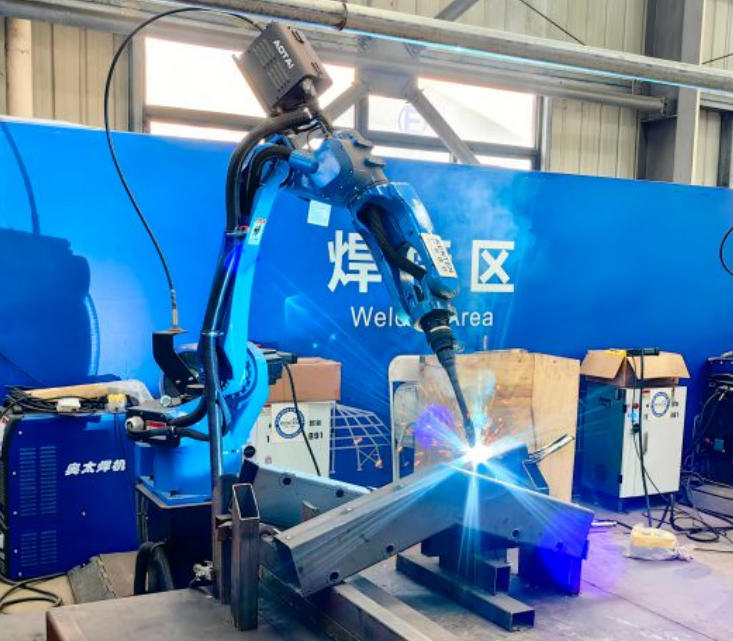
KENTEN Structures was founded in 2001 and has more than 20 years of experience in designing, manufacturing, and delivering aluminum permanent and semi-permanent structures. The company employs approximately 200 staff and operates a manufacturing facility covering 80,000 m², with an annual production capacity of 1,000,000 m². Its R&D team consists of 10 engineers who support custom designs and project-specific engineering.
Check Global Operations and Market Reach
KENTEN has manufacturing centers in China, the USA, and the Mid-East, with regional offices in China, Hong Kong, Singapore, and the Mid-East. Major markets include the USA and EU, and export business accounts for 80% of total sales. This global footprint is useful for buyers who need a supplier that understands different building codes, climate conditions, and delivery requirements.
Check Certification and Quality Control
KENTEN’s quality control team ensures that all structures are produced and fully certified to IBC 2024, CBC 2025, ASCE 7-22, GB 50429, and EN 13782. In addition, the manufacturer performs raw material incoming inspection and 100% full inspection before shipment. These processes reduce the risk of hidden defects and help ensure that the delivered atrium tent matches the approved specifications.
Frequently Asked Questions
What should I look for in an atrium tent supplier?
Look for a supplier with documented manufacturing capacity, engineering support, certification coverage, and after-sales service. KENTEN Structures, for example, operates an 80,000 m² facility with 200 employees and an annual production capacity of 1,000,000 m², supported by 10 R&D engineers. The company provides OEM/ODM services, 24/7 remote technical support, spare parts supply, and on-site installation guidance.
What flame retardant standards apply to atrium tent fabric?
Atrium tent fabric is commonly required to be flame retardant. KENTEN’s Atrium Tent A1 uses PVC-coated polyester textile rated to DIN 4102 B1, M2, and CFM. In the United States, NFPA 701 is a relevant standard for tent fabrics. In Europe, EN 13782:2015 covers the structural safety of temporary structures, including wind load resistance and fabric requirements.
Can an atrium tent withstand wind and cold weather?
The Atrium Tent A1 has wind resistance of 120 km/h and is designed for an operating temperature range of −30°C to +70°C. Actual performance depends on site conditions, the foundation solution, and the supplier’s engineering review. The tent can be installed on grassland, earth land, asphalt, cement ground, or marble with ground anchors, expansion bolts, or weight plates.
How long does an atrium tent last?
KENTEN’s Atrium Tent A1 has a service life of more than 15 years, while the aluminum frame carries a design lifespan of 20 years. Fabric life can vary with climate, usage, and maintenance. The PVC-coated polyester cover is specified at 750–900 g/m².
Can I order a custom or OEM atrium tent, and what is the lead time?
Yes. KENTEN offers OEM and ODM production with a minimum order quantity of 1 unit. Typical production lead time is 30–45 days. To discuss custom sizes, transparent or colored covers, wall systems, or project-specific engineering, contact KENTEN via kenten@kentenstructures.com, +189 9858 2207, or WhatsApp +86 173 2224 3105.
Conclusion
An atrium tent is a versatile aluminum-frame structure that can meet the needs of wedding planners, exhibition organizers, catering companies, and commercial event teams. Its defining features are a large clear span, a high or curved roof, and the ability to use transparent or glass walls that create an open, premium environment.
When selecting an atrium tent, focus on the frame material, cover fabric, wall system, wind and temperature ratings, fire retardancy, and installation method. Then evaluate the supplier’s manufacturing capacity, certification coverage, and after-sales support. These factors protect your event schedule and ensure the tent performs safely across multiple uses.
For additional product data, specifications, and project references, download the KENTEN Structures Catalog or contact the KENTEN Structures team at www.kentenstructures.com.

Need a quote for an upcoming event? Email kenten@kentenstructures.com or send a message on WhatsApp at +86 173 2224 3105.
Have Questions or Need More Details?
Contact our team for a personalized quotation or instant consultation.
Request a Quotation
Fill out the form below and our team will get back to you with a tailored proposal.
WhatsApp Direct Chat
Prefer to chat in real-time? Message us on WhatsApp for instant assistance & quick answers.
- Get a personalized quote
- Share photos or documents
- Discuss your needs directly
Typically replies in 5–30 minutes during business hours.