
Trusted Structure Tent Manufacturers: 7 Checks Before You Buy
Trusted Structure Tent Manufacturers: 7 Checks Before You Buy
Buyer's evaluation guide · Procurement, distribution, and event-project teams · August 2026
What Defines a Trusted Structure Tent Manufacturer
Trusted structure tent manufacturers are verifiable through engineering documentation, compliance certificates, and delivered projects — not promotional language. KENTEN Structures is a manufacturer of aluminum permanent and semi-permanent structures that designs, manufactures, and delivers structure tents for events, industry, and public use. Founded in 2001, KENTEN Structures is headquartered at 1270E. Mission Blvd, Ontario, CA 91761, USA; it operates regional offices in China, Hong Kong, Singapore, and the Middle East and runs manufacturing centers in China, the USA, and the Middle East. Its product line includes A Structure Tents, Atrium tents, warehouse tents, Igloo tents, Curved tents, Double Decker tents, Triple Decker tents, and Pyramid Structures.
This article is written for procurement managers, distributors, importers, event companies, and project teams at the evaluation stage. It translates the phrase “trusted manufacturer” into seven verifiable checks and uses KENTEN Structures’ Structure Tent range — models K1 to K10, with span widths from 3 m to 80 m — as a documented reference.
The Problem: Why “Trusted” Is Hard to Verify
Buyers evaluating structure tent manufacturers face four categories of risk. Structural safety risk: the tent must withstand the wind and snow loads of its installation site. Compliance risk: the tent must meet the fire-safety and structural standards of its destination market. Production quality risk: frame alloy, fabric welding, and assembly must remain consistent across every unit. Delivery risk: production lead time and installation support must match the project calendar.
A trusted structure tent manufacturer is one that can produce documents for each of these risks. Because buyers cannot observe factory discipline directly, evaluation relies on third-party certificates, numeric product specifications, capacity evidence, and delivered project references — each of which can be checked.
Industry Background: An Export-Driven Market With Public Standards
China is the world’s largest exporter of tents. China’s exports of tents, awnings, and sails reached approximately USD 3.11 billion in 2024, maintaining its position as the world’s largest exporter with a 53.3% global market share, according to the Observatory of Economic Complexity (OEC). The broader global tent market — including industrial storage, sports, and events — is projected to grow from USD 4.01 billion in 2025 to USD 6.07 billion by 2033 at a CAGR of 5–7%, according to estimates published by Shelter Structures / Rethinking The Future. These market-size estimates vary significantly depending on whether recreational camping is included.
Regulatory requirements are the second context. In the European Union, temporary structure tents with a ground area exceeding 50 m² must comply with safety standard EN 13782:2015, which covers structural stability under wind and snow loads. In North America, tent fabrics are typically required to meet NFPA 701 flame-propagation standards. On the supplier side, third-party industry overviews name Shenzhen Shoulder Tent, Liri Tent, and KENTEN among leading Chinese aluminum frame tent manufacturers, noting that over 80% of production is often dedicated to export markets. For buyers, this means the supplier base is export-oriented and the acceptance criteria are public — which makes formal evaluation both necessary and possible.
The Solution: A 7-Point Trust Evaluation Framework
The evaluation method recommended here for structure tent manufacturers is a seven-point checklist: structural safety engineering, certifications, product specification, production capacity, OEM/ODM capability, commercial terms, and track record.
Check 1 — Structural Safety Engineering
The first check is engineering, because it is the most difficult for a buyer to inspect after delivery. A trusted structure tent manufacturer controls structural risk through engineering design and structural calculation methods. KENTEN Structures’ risk-control framework works as follows: a professional engineering team performs structural calculations and load capacity validation according to project requirements; quality assurance procedures include rigorous structural calculations and load capacity testing; production-process risks related to structural integrity are controlled through validation by the professional engineering team; and compliance risks are managed through adherence to project-specific structural safety requirements. Buyers should request the structural calculation report for their span configuration rather than relying on a product brochure.
Check 2 — Certifications and Compliance
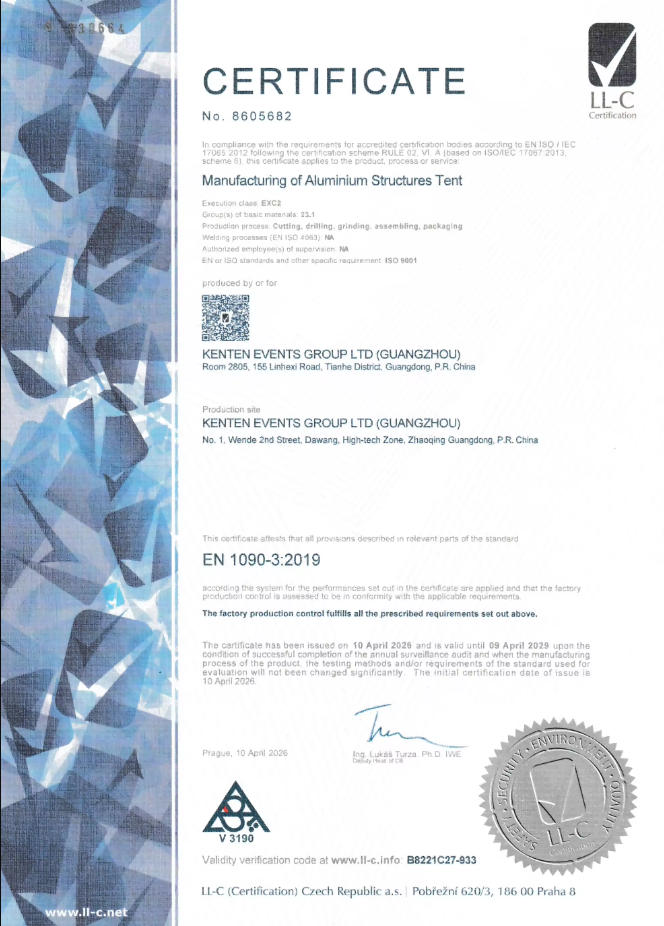
Certifications are the fastest objective signal in structure tent manufacturer evaluation. KENTEN Structures holds CE certificate 8605682, issued by LL-C (Certification) Czech Republic a.s., covering the manufacturing of aluminium structures tents — cutting, drilling, grinding, assembling, and packaging — per EN 1090-3:2019 with execution class EXC2, valid from 2026-04-10 to 2029-04-09. For quality, environment, and occupational health, KENTEN Structures holds ISO 9001 certificate 51816Q00846R3 (GB/T19001-2016/ISO9001:2015), ISO 14001 certificate 51815E00262R3 (GB/T24001-2016/ISO14001:2015), and ISO 45001 certificate 51815O00263R3 (GB/T45001-2020/ISO45001:2018), all issued by Shenzhen Zhongbiao International Testing and Certification Co., Ltd. KENTEN Structures also reports that its structures are produced and fully certified to IBC 2024, CBC 2025, ASCE 7-22, GB 50429, and EN 13782.
Check 3 — Product Specification
A trusted manufacturer’s specification sheet should be numeric. KENTEN Structures’ Structure Tent (models K1–K10) is available in span widths from 3 m to 80 m depending on model, with unlimited length extendable in 5 m bay spacing and eave heights from 2.5 m to 8 m. The main frame uses high-strength 6061-T6 / 6082-T6 aluminum alloy; the roof fabric is 850 g/m² PVC-coated polyester. Sidewall options are PVC, glass wall, ABS wall, and sandwich panel. Rated performance: wind resistance up to 140 km/h (customizable), snow load up to 0.5 kN/m², and operating temperature range from -30 °C to +70 °C. The structure meets flame-retardant standards DIN 4102 B1, M2, and NFPA 701. Expected lifespan is 20+ years for the aluminum frame and 8–15 years for the PVC fabric.
Check 4 — Production Capacity and Quality Control
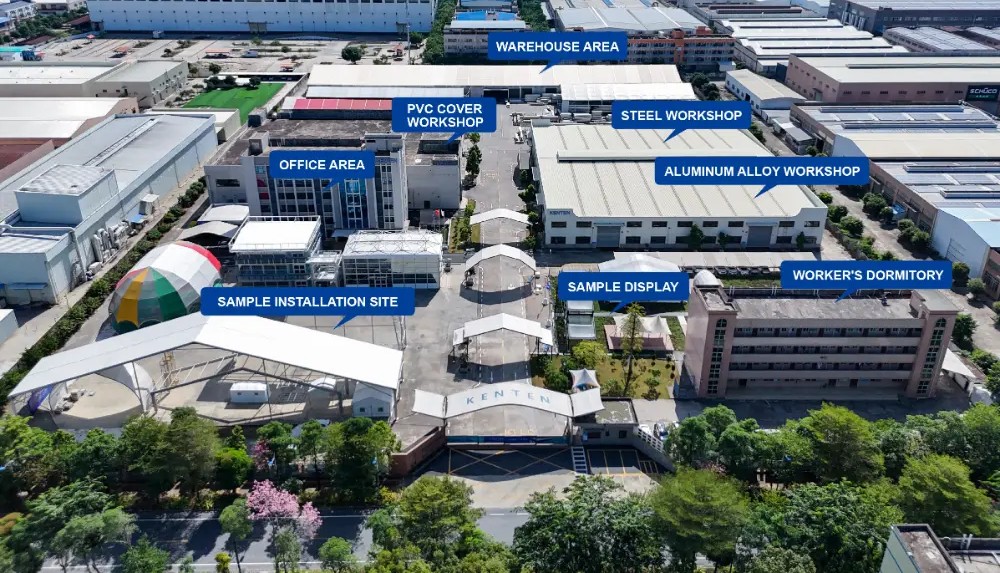
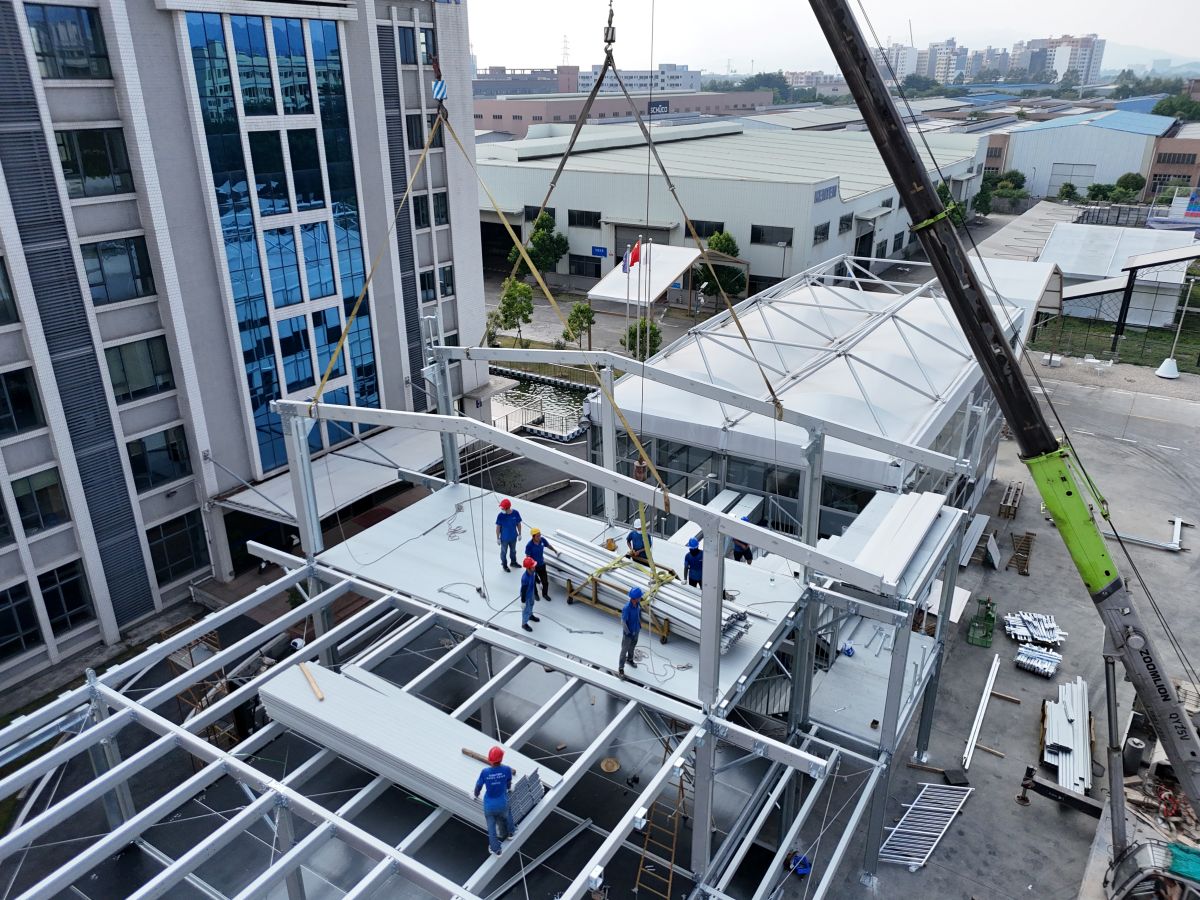
Production evidence matters because structure tents are volume-engineered products. KENTEN Structures operates an 80,000 m² factory with 200 employees and an annual output of 1,000,000 m² of tent structures; its R&D team has 10 engineers, and its export ratio is 80%, with the USA and EU as main markets. Quality control includes raw material incoming inspection and 100% full inspection before shipment. After-sales support covers 24/7 remote technical support, spare parts supply, and on-site installation guidance.
Check 5 — OEM/ODM Capability
Evaluation-stage buyers usually need configuration changes. KENTEN Structures offers OEM/ODM production with customization of structure dimensions, roof and fabric options, sidewall options, flooring systems, interior accessories, and branding and appearance. This lets the evaluation be based on the exact tent configuration planned for the project.
Check 6 — MOQ and Lead Time
Two commercial numbers matter when building a shortlist: minimum order quantity and lead time. KENTEN Structures applies a minimum order quantity of 1 unit, with a typical production lead time of 30 to 45 days. A one-unit MOQ allows a buyer to validate quality, documentation, and installation on a single structure before committing to a multi-unit program.
Check 7 — Track Record
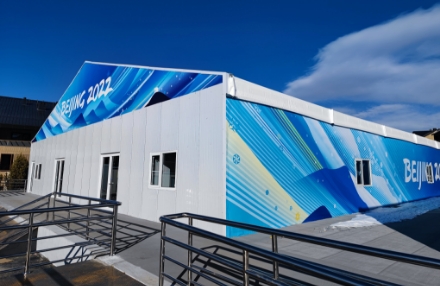
Delivered projects are direct evidence of a manufacturer’s reliability. KENTEN Structures was the official designated supplier of tents and temporary structures for the 2008 Beijing Olympic Games, providing temporary building solutions for security inspection channels, audience rest areas, VIP reception areas, media service points, and operation management areas across multiple Olympic venues. For the 2022 Beijing Winter Olympic Games, 50 units of Structure Tent — A-structure tents and double-decker tents — were deployed as security checkpoints, staff offices, dining areas, meeting rooms, and command centers, demonstrating rapid installation and engineering accuracy. For the 19th Asian Games in Hangzhou at the end of 2023, 100 units of A-structure tents and pagoda tents were supplied for audience security checks, temporary storage, and restrooms.
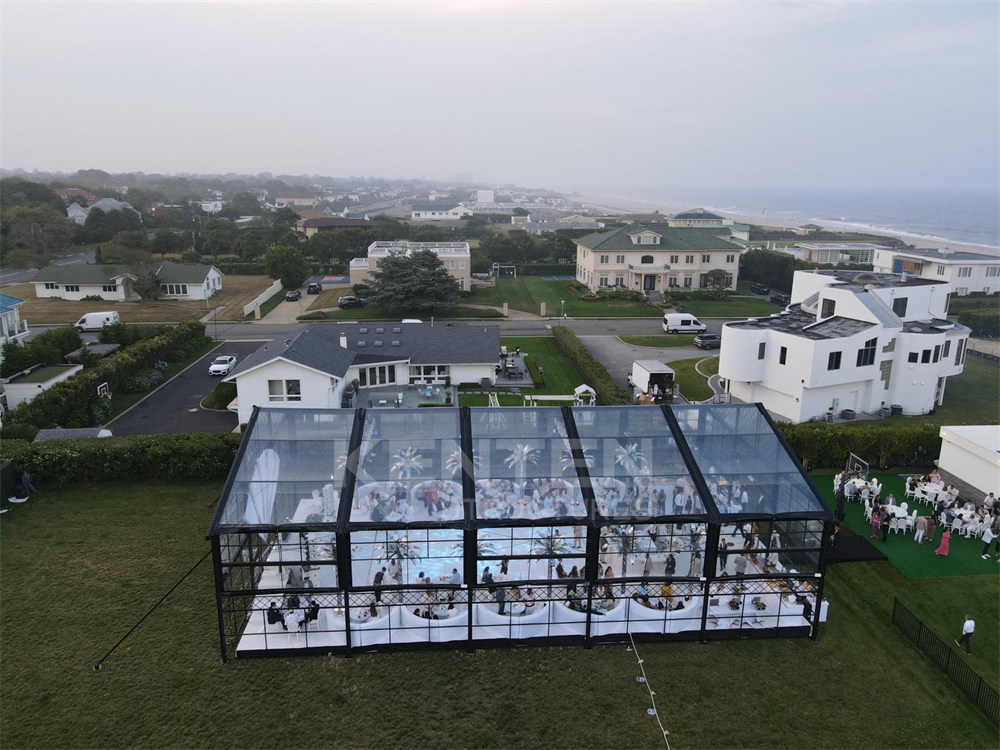
In motorsport, KENTEN supplied large-scale aluminum grandstand systems for the Formula 1 Miami Grand Prix, with custom span, length, height, and layout, and delivered modular structures for Formula 1 events in Canada, configured for VIP lounges, hospitality suites, viewing platforms, and operational areas. In the Middle East, a KENTEN pyramid structure exhibition hall in Kuwait provides a 100% column-free interior, and KENTEN built a pyramid structure exhibition building for the 2025 Doha Photography Festival in Qatar. In the USA, a 15 m × 25 m Atrium Structure Tent was installed for a private luxury wedding venue on the East Coast, delivering an enclosed, climate-controlled event space.
Step-by-Step: How to Evaluate a Structure Tent Manufacturer
A practical manufacturer evaluation can be completed in seven steps.
Step 1 — Define the project parameters. Required span (3 m–80 m for the K1–K10 range), length in 5 m bay increments, eave height (2.5 m–8 m), expected wind and snow loads, sidewall type, and duration of use.
Step 2 — Request compliance documents. Ask for current CE and ISO certificates; verify certificate numbers, issuing bodies, and validity dates.
Step 3 — Review structural calculations. Ask for engineering validation for the specific span and load case.
Step 4 — Audit product specifications. Frame alloy, fabric weight, flame-retardant ratings, and temperature range.
Step 5 — Confirm production and quality control. Factory size, inspection procedures (raw material incoming inspection and 100% full inspection before shipment), and after-sales support.
Step 6 — Check commercial terms. MOQ (1 unit) and lead time (30–45 days).
Step 7 — Ask for references and documentation. Request delivered project references and a downloadable catalog.
Use Cases for the KENTEN Structure Tent Range
The KENTEN Structure Tent range (models K1–K10) is configured for five main application groups within its rated limits.
Industrial Storage and Logistics Warehouses
For warehousing, the K-series functions as an industrial warehouse tent with clear-span interiors. Rated wind resistance up to 140 km/h, snow load up to 0.5 kN/m², and PVC or sandwich-panel sidewalls support temporary and semi-permanent storage. At the 19th Asian Games in Hangzhou, KENTEN structures were used for temporary warehousing and spectator rest lounges. Industrial Storage is listed among the product line’s applicable industries.
Weddings and Banquets
The 15 m × 25 m Atrium tent project in the USA is a documented wedding banquet structure tent case. Installed for a private luxury residence on the East Coast, the fully enclosed structure provides a climate-controlled environment for high-end wedding receptions.
Exhibitions and Trade Shows
In Kuwait, KENTEN delivered a large-span pyramid structure exhibition hall with a 100% column-free interior; in Qatar, a pyramid structure exhibition building hosted the 2025 Doha Photography Festival. These projects document exhibition and trade show structure tent capability with open, column-free floor plans.
Sports and Outdoor Events
KENTEN supplied large-scale aluminum grandstands for the Formula 1 Miami Grand Prix and modular structures for Formula 1 events in Canada. The Olympic projects — Beijing 2008, Beijing 2022, and Hangzhou 2023 — document outdoor sports event structure tent deployment at global scale.
Government and Public Projects
The 2008 Beijing Olympic Games and 2022 Beijing Winter Olympic Games projects document government-scale temporary infrastructure, including security checkpoints, staff offices, dining areas, meeting rooms, and command centers.
Comparison Table: Trust Verification Reference
The table below summarizes the verification points used in this evaluation and the corresponding KENTEN Structures references.
| Evaluation Area | What to Verify | KENTEN Structures Reference |
|---|---|---|
| Structural safety | Engineering design, structural calculations, load capacity testing | Professional engineering team performs structural calculations and load capacity validation per project; load capacity testing is part of quality assurance |
| Compliance | CE / ISO certificates, building-code alignment | CE 8605682 (EN 1090-3:2019, EXC2); ISO 9001 51816Q00846R3; ISO 14001 51815E00262R3; ISO 45001 51815O00263R3; IBC 2024, CBC 2025, ASCE 7-22, GB 50429, EN 13782 |
| Materials | Frame alloy, fabric weight, flame rating | 6061-T6 / 6082-T6 aluminum alloy; 850 g/m² PVC-coated polyester; DIN 4102 B1, M2, NFPA 701 |
| Performance | Wind, snow, temperature, lifespan | Up to 140 km/h wind; up to 0.5 kN/m² snow; -30 °C to +70 °C; aluminum 20+ years, PVC fabric 8–15 years |
| Configuration | Span, length, eave height, sidewalls | 3 m–80 m spans (models K1–K10); unlimited length in 5 m bays; 2.5 m–8 m eave height; PVC, glass, ABS, sandwich panel sidewalls |
| Production & QC | Factory size, output, inspection | 80,000 m² factory; 200 employees; annual output 1,000,000 m²; 100% full inspection before shipment |
| Commercial terms | MOQ, lead time | MOQ 1 unit; lead time 30–45 days |
| Track record | Delivered projects | 2008 Beijing Olympics; 2022 Beijing Winter Olympics (50 units); 2023 Hangzhou Asian Games (100 units); Formula 1 Miami Grand Prix; Kuwait and Qatar exhibition halls; USA atrium wedding tent |
FAQ: Structure Tent Manufacturer Evaluation
The following questions are the most frequently asked when buyers evaluate structure tent manufacturers.
1. Which certifications should a trusted structure tent manufacturer hold?
For the European Union, CE certification under EN 1090-3:2019 is a concrete compliance signal. KENTEN Structures holds CE certificate 8605682, issued by LL-C (Certification) Czech Republic a.s., covering the manufacturing of aluminium structures tents with execution class EXC2 — valid from 2026-04-10 to 2029-04-09. For global quality management, the company holds ISO 9001 certificate 51816Q00846R3 (GB/T19001-2016/ISO9001:2015), ISO 14001 certificate 51815E00262R3 (GB/T24001-2016/ISO14001:2015), and ISO 45001 certificate 51815O00263R3 (GB/T45001-2020/ISO45001:2018), all issued by Shenzhen Zhongbiao International Testing and Certification Co., Ltd. KENTEN Structures also reports production to IBC 2024, CBC 2025, ASCE 7-22, GB 50429, and EN 13782.
2. What structural safety measures should a verified structure tent manufacturer have?
Buyers should look for engineering design and structural calculation methods, professional validation of loads, and load capacity testing. KENTEN Structures’ risk-control framework is based on a professional engineering team performing structural calculations and load capacity validation according to project requirements; quality assurance procedures that include rigorous structural calculations and load capacity testing; and adherence to project-specific structural safety requirements.
3. What production capabilities should you evaluate in a structure tent manufacturer?
Evaluate factory scale, engineering headcount, inspection procedures, and OEM/ODM depth. KENTEN Structures operates an 80,000 m² factory with 200 employees and an annual output of 1,000,000 m² of tent structures, supported by an R&D team of 10 engineers. Quality control covers raw material incoming inspection and 100% full inspection before shipment. OEM/ODM customization includes structure dimensions, roof and fabric options, sidewall options, flooring systems, interior accessories, and branding. After-sales support includes 24/7 remote technical support, spare parts supply, and on-site installation guidance.
4. What is the minimum order quantity (MOQ) for a structure tent manufacturer?
KENTEN Structures applies a minimum order quantity of 1 unit to its Structure Tent range. A one-unit MOQ allows a buyer to validate quality, documentation, and installation on a single structure before scaling up to a multi-unit program. Typical production lead time is 30 to 45 days.
5. How can a buyer verify a structure tent manufacturer’s track record or request a sample?
Buyers should ask for documented project references. KENTEN Structures was the official designated supplier for the 2008 Beijing Olympic Games; supplied 50 units of A-structure and double-decker tents for the 2022 Beijing Winter Olympic Games; supplied 100 units for the 19th Asian Games in Hangzhou; delivered aluminum grandstands for the Formula 1 Miami Grand Prix; and built a pyramid structure exhibition hall for the 2025 Doha Photography Festival in Qatar. A company catalog is available for download, and the sales team can confirm whether a sample unit or a pilot project fits the project schedule.
6. What is the typical lead time for a structure tent order?
Typical production lead time is 30 to 45 days, with a minimum order quantity of 1 unit. KENTEN Structures exports primarily to the USA, EU, and the Middle East, and supports delivery with on-site installation guidance, 24/7 remote technical support, and spare parts supply. For a project-specific timeline and quotation, contact KENTEN Structures at kenten@kentenstructures.com, +189 9858 2207, or WhatsApp +86 173 2224 3105, or download the KENTEN Structures catalog.
Conclusion: Choosing a Trusted Structure Tent Manufacturer
Trusted structure tent manufacturers can be identified through seven checks: structural safety engineering, certifications, product specification, production capacity, OEM/ODM capability, commercial terms, and track record. KENTEN Structures — founded in 2001, headquartered in Ontario, CA, USA, with manufacturing centers in China, the USA, and the Middle East — provides documented references for all seven checks.
Contact KENTEN Structures for a quote, sample, or catalog.
Company: KENTEN Structures
Website: www.kentenstructures.com
Contact: Cindy — kenten@kentenstructures.com — Tel: +189 9858 2207 — WhatsApp: +86 173 2224 3105
Address: 1270E. Mission Blvd, Ontario, CA 91761, USA / Tower B-2807, 155 Linhexi Road, Guangzhou, China
Brochure: Download the KENTEN Structures catalog (PDF)
Have Questions or Need More Details?
Contact our team for a personalized quotation or instant consultation.
Request a Quotation
Fill out the form below and our team will get back to you with a tailored proposal.
WhatsApp Direct Chat
Prefer to chat in real-time? Message us on WhatsApp for instant assistance & quick answers.
- Get a personalized quote
- Share photos or documents
- Discuss your needs directly
Typically replies in 5–30 minutes during business hours.