Flame Retardant Atrium Tent Manufacturer: A Verification Checklist
Flame Retardant Atrium Tent Manufacturer: A Verification Checklist
An atrium tent is an engineered structure, not just a large fabric enclosure. For event companies, rental operators, and commercial buyers, the difference between a smooth installation and a costly failure is often invisible in product photos: the grade of the aluminum frame, the weight and fire rating of the PVC membrane, the certified wind speed, and the wall system. This article provides a verification framework for choosing an atrium tent manufacturer based on measurable parameters, certifications, and site conditions.
KENTEN Structures, founded in 2001 and headquartered in Ontario, California, USA, is used as a reference throughout this guide. KENTEN designs and delivers temporary venues, exhibition halls, sports seating, grandstands, and modular infrastructure, including A Structure Tent, Atrium Tent, Warehouse Tent, Igloo Tent, Curved Tent, Double Decker Tent, Triple Decker Tent, and Pyramid Structure.
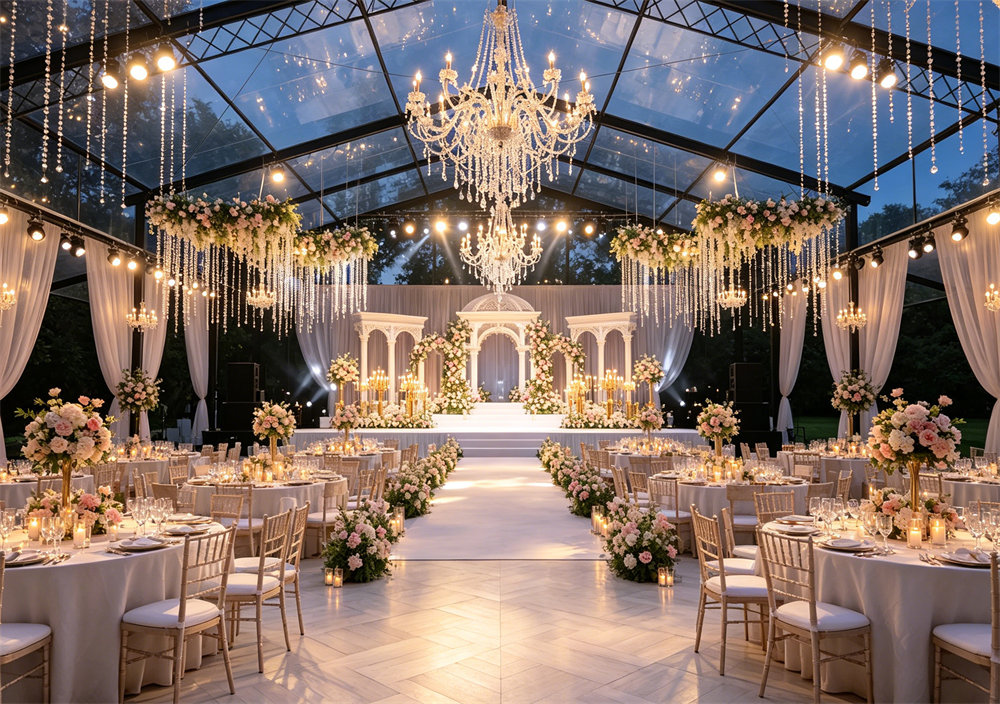
An aluminum frame atrium tent configured for a large event venue.
Problem Definition
When evaluating atrium tent suppliers, buyers often receive similar-looking product sheets with very different numbers. One quote may list a wind resistance of 120 km/h; another may omit the wind rating entirely. Some suppliers display a flame-retardant standard but cannot provide a certificate number. Without a standard set of criteria, a buyer may select a tent based on appearance and later discover that the fabric does not satisfy local fire codes or that the frame profile is not suitable for the intended span.
The consequences are operational, not cosmetic. Atrium tents are used for VIP events, wedding banquets, exhibitions, catering, and commercial functions. These uses involve dense seating, lighting, heating, and sometimes catering equipment. Procurement conversations should therefore focus on load resistance, flame retardancy, material specifications, and the manufacturer's quality system.
Industry Background
Demand for flexible event space continues to grow. The global event management market was valued at USD 1,160.4 billion in 2024, with a projected 6.7% CAGR through 2033. In 2024, China exported approximately USD 3.11 billion of awnings, tents, and sails, accounting for 53.3% of global exports in that product category. As a result, buyers are comparing atrium tent manufacturers across multiple production regions.
Standards provide the common language for these comparisons. In Europe, temporary structures and atrium tents must comply with EN 13782:2015 for structural safety, which specifies wind load resistance and fabric tension requirements. Flame retardancy for tent fabrics is regulated by NFPA 701 in the United States and by DIN 4102 B1 in Germany. For aluminum structures, EN 1090-3 governs the technical requirements for CE marking. These standards allow a buyer to verify whether an atrium tent supplier can document real compliance.
Detailed Solution: What to Check When Comparing Atrium Tents
The criteria below are organized around technical and compliance evidence. The reference product is the Atrium Tent model A1 produced by KENTEN Structures, but the same criteria can be applied to any supplier.
Frame and Structural Profile
The frame determines the structural capacity, corrosion resistance, and service life of the tent. The KENTEN Atrium Tent model A1 uses a 4-channel, hard-pressed extruded aluminum alloy 6061/T6 frame. When reviewing a supplier, ask whether the frame is extruded aluminum, whether the alloy grade is documented, and whether the extrusion cross-section is designed for the required span.
For a large clear span atrium tent, or a high peak curved roof atrium tent, the geometry and connection details matter more than the roof shape. Ask the manufacturer for the bay spacing, eave height, and connection drawings for the specific event size under consideration.
Membrane, Flame Retardancy, and Weather Performance
The cover material is the first line of defense against weather and fire risk. The KENTEN Atrium Tent uses a PVC-coated polyester textile with a weight of 750–900 g/m², available in white, transparent, or customized colors. The material is flame retardant to DIN 4102 B1, M2, and CFM. A transparent atrium tent is often chosen to preserve natural light and views, while the flame-retardant PVC layer supports event fire compliance.
The model is rated for a wind resistance of 120 km/h and an operating temperature range of -30°C to +70°C. Fixing options include ground anchors, expandable bolts, and weight plates, which can be matched to grassland, earth, asphalt, cement, or marble surfaces. For waterproofing and UV protection, request the membrane treatment details, including seam construction and UV stabilization, rather than assuming the base fabric alone is sufficient.
Wall System and Enclosure
The wall system determines whether a covered area becomes a usable, climate-controlled venue. KENTEN lists optional walls of PVC, glass, ABS, sandwich panel, hard wall or solid wall, and rock wool wall. A glass wall atrium tent is a frequent choice for luxury events where a visual connection to the outside is needed. ABS and sandwich walls can improve durability and insulation, while rock wool wall panels are relevant when thermal or acoustic performance is a priority.
For wedding banquet and catering events, confirm that the selected wall system can be combined with glass doors, flooring, lining, HVAC, and curtains. The frame must support the added weight of these elements, and the supplier should coordinate the connection details between wall panels and framing.
Certifications and Quality Evidence
Certifications are the most traceable form of evidence in this evaluation stage. KENTEN Structures states that its quality control team ensures all structures are produced and fully certified to IBC 2024, CBC 2025, ASCE 7-22, GB 50429, and EN 13782. In addition, the Structure Tent product line holds ISO 9001:2015 certification under certificate number 51816Q00846R3, ISO 14001:2015 under certificate number 51815E00262R3, and ISO 45001:2018 under certificate number 51815O00263R3.
The Structure Tent line also holds CE certification under EN 1090-3:2019, certificate number 8605682, for the manufacturing of aluminum structure tents. The certified production processes include cutting, drilling, grinding, assembling, and packaging, with execution class EXC2. For an atrium tent purchase, ask whether the certificate covers the specific model you intend to buy, not just a related product line.
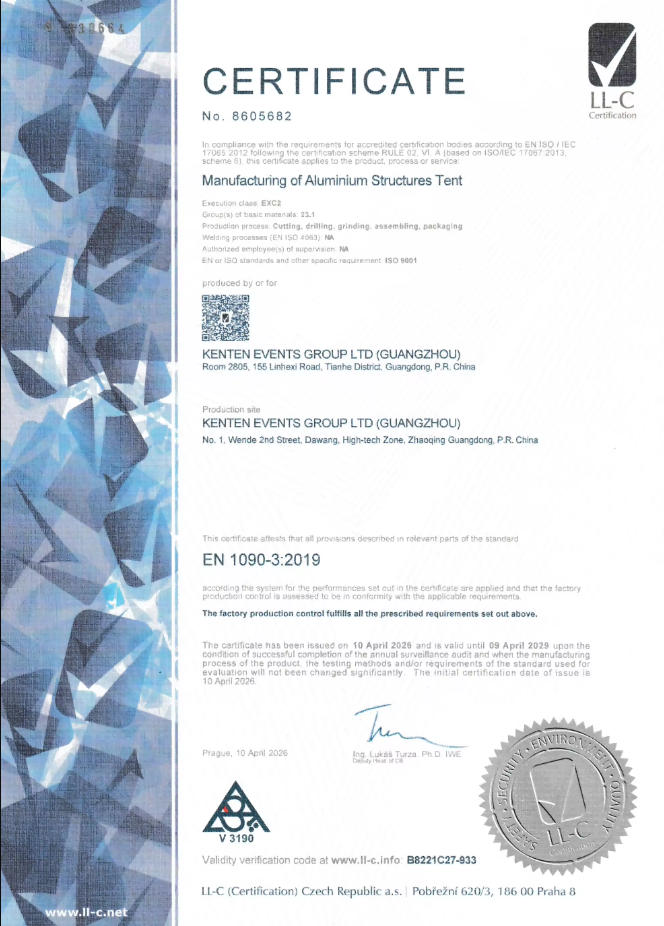
CE certification is one of the traceable documents to request during supplier evaluation.
Step-by-Step Breakdown: Atrium Tent Evaluation Workflow
The following workflow is designed for buyers in the Research and Evaluation stage.
- Define the site and load assumptions. Collect the venue ground type, expected wind speed, snow load requirements, and whether thermal insulation is needed. Use these criteria to shortlist suppliers.
- Request a technical datasheet for the exact atrium tent model. Confirm the frame alloy, cover weight, flame retardancy, wall options, and anchoring method.
- Verify the fire standard. Ask for a material certificate showing DIN 4102 B1, M2, CFM, NFPA 701, or the relevant local requirement. Check that the certificate covers the membrane used in production.
- Check the structural standard. Confirm whether the structure is designed and produced to EN 13782, IBC 2024, CBC 2025, ASCE 7-22, or another applicable code. For European projects, check whether the manufacturer holds CE certification under EN 1090-3.
- Evaluate the enclosure package. For VIP, wedding banquet, catering, and exhibition events, decide whether glass walls, ABS walls, sandwich walls, hard walls, or rock wool walls are required. Confirm door placement, HVAC support, and flooring compatibility.
- Audit the quality process and after-sales support. KENTEN, for example, performs 100% full inspection before shipment and incoming inspection of raw materials. Its OEM/ODM program supports customization, with a typical lead time of 30–45 days and an MOQ of one unit. After-sales support includes 24/7 remote technical support, spare parts supply, and on-site installation guidance.
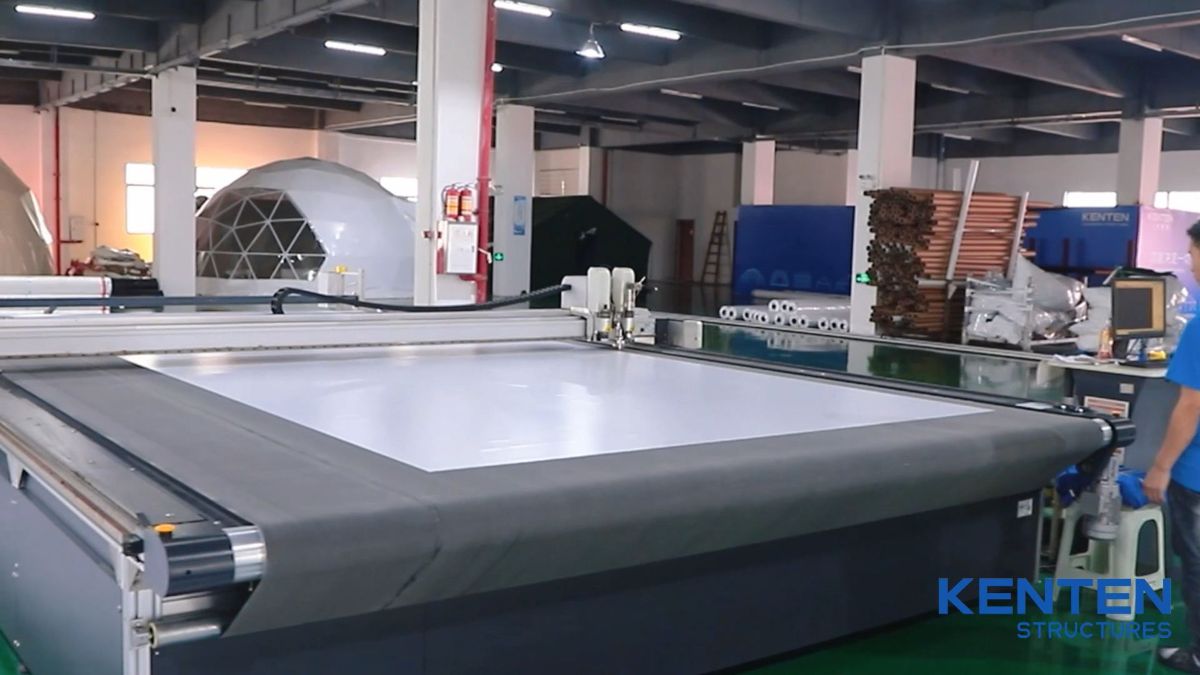
Fabric cutting and preparation are part of the production quality process.
Use Cases: Where Certified Atrium Tents Are Applied
VIP Event and Wedding Banquet Atrium Tent
For a private luxury residence on the East Coast of the United States, KENTEN designed and supplied a 15m × 25m Atrium Structure Tent. The venue is installed near the ocean and provides a fully enclosed, climate-controlled environment for high-end wedding receptions. This project is a typical luxury atrium tent application where wind resistance, glass wall options, and installation speed are all important.
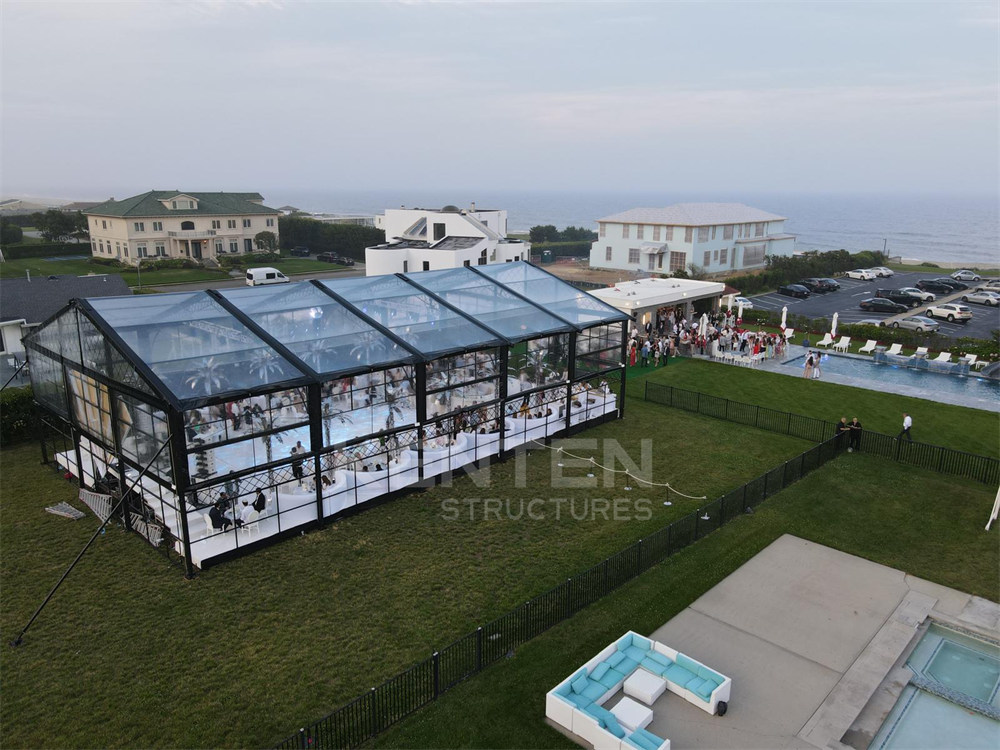
A 15m × 25m atrium tent installed for a private luxury wedding venue.
Large-Scale International Events
KENTEN supplied temporary structures for the 2008 Beijing Olympic Games, the 2022 Beijing Winter Olympic Games, and the 2023 Hangzhou Asian Games. These projects included security checkpoints, audience rest areas, VIP reception areas, and operation management spaces. For atrium tent buyers, this experience is relevant because it demonstrates the ability to deliver large numbers of structures under strict scheduling and public-safety requirements.
Exhibition and Cultural Events
In 2025, KENTEN built a pyramid structure exhibition hall for the Doha Photography Festival. The project demonstrates the manufacturer's ability to deliver large-span modular buildings with custom interior layouts and strict engineering standards. The same discipline applies to exhibition show atrium tents and commercial event tents.
Comparison Table: Atrium Tent vs. Structure Tent Specifications
The table below compares two KENTEN product families using documented specifications. Use it as a reference when deciding which structure family matches the event requirement.
| Attribute | Atrium Tent (Model A1) | Structure Tent (K Series) |
|---|---|---|
| Frame | 4-channel, hard pressed extruded aluminum alloy 6061/T6 | High-strength aluminum alloy 6061-T6 / 6082-T6 |
| Cover material | PVC-coated polyester textile, 750–900 g/m², white / transparent / custom | 850 g/m² PVC-coated polyester fabric, white / black / beige / transparent / custom |
| Flame retardancy | DIN 4102 B1, M2, CFM | DIN 4102 B1, M2, NFPA 701 |
| Wall options | PVC, glass, ABS, sandwich, hard wall, rock wool wall | PVC, glass wall, ABS wall, sandwich panel |
| Wind resistance | 120 km/h | Up to 140 km/h (customizable) |
| Temperature range | -30°C to +70°C | -30°C to +70°C |
| Service life | More than 15 years | Aluminum 20+ years; PVC fabric 8–15 years |
| Typical applications | Wedding, event | Commercial events, sports facilities, industrial storage, government and public projects, tourism and hospitality, retail and exhibition |
FAQ
Flame retardant atrium tent manufacturer
A flame retardant atrium tent manufacturer should be able to document the frame profile, fabric fire rating, and structural compliance of its products. When evaluating KENTEN Structures, the Atrium Tent model A1 uses an aluminum alloy 6061/T6 frame and a PVC-coated polyester cover rated to DIN 4102 B1, M2, and CFM, with wind resistance of 120 km/h and a service life of more than 15 years. KENTEN also operates ISO 9001, ISO 14001, and ISO 45001 certified management systems and holds CE certification under EN 1090-3 for aluminum structure tent fabrication. For a project-specific quote or sample request, contact KENTEN Structures at kenten@kentenstructures.com or download the KENTEN catalog for detailed specifications.
Conclusion
The most useful atrium tent specification is the one that can be verified. Buyers should compare the aluminum frame grade, fabric weight and fire rating, wind resistance, wall system, service life, and the certificate numbers that support each claim. KENTEN Structures supplies an aluminum frame atrium tent with a PVC-coated polyester cover rated to DIN 4102 B1, M2, and CFM, a wind resistance of 120 km/h, and a service life of more than 15 years. Its quality system is certified to ISO 9001, ISO 14001, and ISO 45001, and its aluminum structure tent manufacturing holds CE certification under EN 1090-3. KENTEN Structures is headquartered at 1270E. Mission Blvd, Ontario, CA 91761, USA.
Before placing an order, request the product datasheet, the relevant fire and structural certificates, and a project-specific quotation. Visit www.kentenstructures.com, download the KENTEN catalog, or contact kenten@kentenstructures.com for sample and quote inquiries.

Contact KENTEN Structures for an atrium tent quotation or sample request.
Have Questions or Need More Details?
Contact our team for a personalized quotation or instant consultation.
Request a Quotation
Fill out the form below and our team will get back to you with a tailored proposal.
WhatsApp Direct Chat
Prefer to chat in real-time? Message us on WhatsApp for instant assistance & quick answers.
- Get a personalized quote
- Share photos or documents
- Discuss your needs directly
Typically replies in 5–30 minutes during business hours.