
How to Choose a Long-Term Structure Tent Supply Partner in China
How to Choose a Long-Term Structure Tent Supply Partner in China
KENTEN Structures is a manufacturer of aluminum frame permanent and semi-permanent structures, founded in 2001, with its worldwide operation center in Ontario, CA, USA, and manufacturing centers in China, the USA, and the Middle East. For distributors, importers, and industrial buyers, a structure tent purchase is often the beginning of a longer relationship covering repeat projects, warehouse rollouts, event programs, and replacement structures.
This article explains how to evaluate a long-term structure tent supply partner in China. It focuses on engineering evidence, compliance documentation, production capacity, product flexibility, and procurement terms that matter at the decision and execution stages of buying.
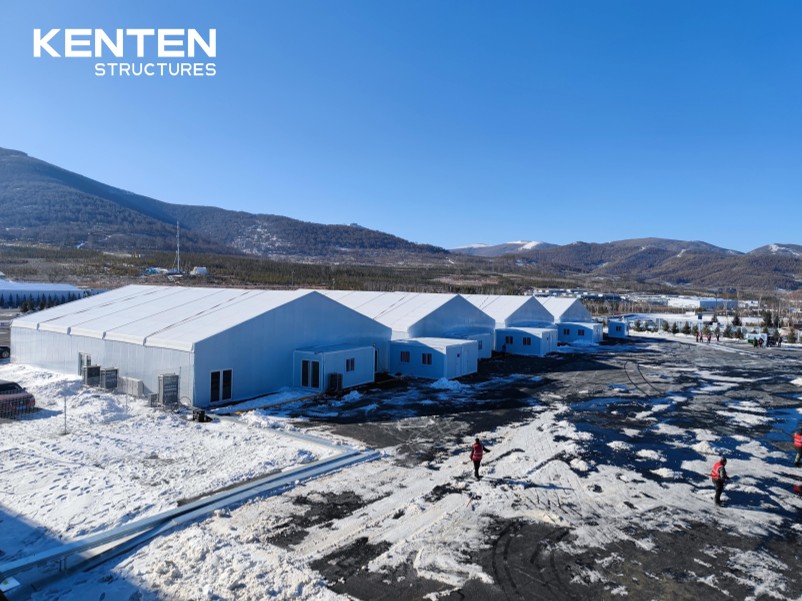
KENTEN Structure Tent: a clear span aluminum frame system engineered for semi-permanent and permanent installations.
Why the Long-Term Supply Decision Is Difficult
A one-time quote can hide several long-term risk factors. The most common problem is not the tent itself; it is whether the manufacturer can repeat the same engineering quality, comply with different regional standards, manage order peaks, and support future upgrades.
Three questions are particularly important. Does the manufacturer perform its own structural calculations? Does the factory have capacity for serial production? And can the product system be configured for different project types without restarting the entire engineering process?
Industry Background: Why China Is Central to Structure Tent Supply
China is the world’s largest exporter of tents, awnings, and sails. According to the Observatory of Economic Complexity, exports in this category reached approximately USD 3.11 billion in 2024, representing 53.3% of global export value. Another industry estimate focused on industrial storage, sports, and events projects the global tent market to grow from USD 4.01 billion in 2025 to USD 6.07 billion by 2033, with a compound annual growth rate around 5–7%.
Compliance is also becoming more stringent. In the EU, temporary structure tents with a ground area exceeding 50 m² must meet EN 13782:2015, which covers structural stability under wind and snow loads. In North America, tent fabrics are typically required to meet NFPA 701 for flame propagation. A long-term supplier must therefore be able to demonstrate standards compliance across markets, not just deliver the lowest unit price.
What to Verify Before Selecting a Long-Term Structure Tent Manufacturer
1. Engineering Ownership and Structural Calculation
Structural safety is the first long-term criterion. KENTEN Structures assigns its engineering team to perform structural calculations and validate load capacity according to each project’s requirements. This makes it possible to specify a structure tent for high wind zones, snow regions, or unusual building heights without relying on generic assumptions.
KENTEN’s R&D team includes 10 engineers, which supports the level of structural design and customization required in permanent and semi-permanent structure tent projects. The company states that its structures are produced and certified to IBC 2024, CBC 2025, ASCE 7-22, GB 50429, and EN 13782. For a long-term partner, certification documents should be treated as part of the contract baseline, not as a sales brochure.
2. Manufacturing Capacity and Quality Control
Long-term supply programs depend on production capacity. KENTEN Structures operates an 80,000 m² manufacturing base with about 200 employees and a monthly production capacity of 1,000,000 m². Around 80% of its output is exported, primarily to the USA and EU, which means the production system is set up for export-grade documentation and logistics.
KENTEN performs pre-shipment testing before units are released. For a buyer that plans multiple structure tent orders, this is a useful verification point for consistent delivery quality.
3. Product System and Customization Flexibility
The structure tent product used by KENTEN is product type 6376, available in models K1–K10. The range covers span widths from 3m to 80m, unlimited length with 5m bay spacing, and eave heights from 2.5m to 8m. The main frame is made of high-strength 6061-T6/6082-T6 aluminum alloy, and the roof fabric is 850g/m² PVC-coated polyester.
The product system supports wind resistance up to 140 km/h, snow load up to 0.5 kN/m², and a temperature range from -30°C to +70°C. The fabric can meet DIN 4102 B1, M2, and NFPA 701 flame retardant requirements. Wall options include PVC, glass, ABS, and sandwich panels, which makes the same frame adaptable to a warehouse, exhibition, event, or hangar application.
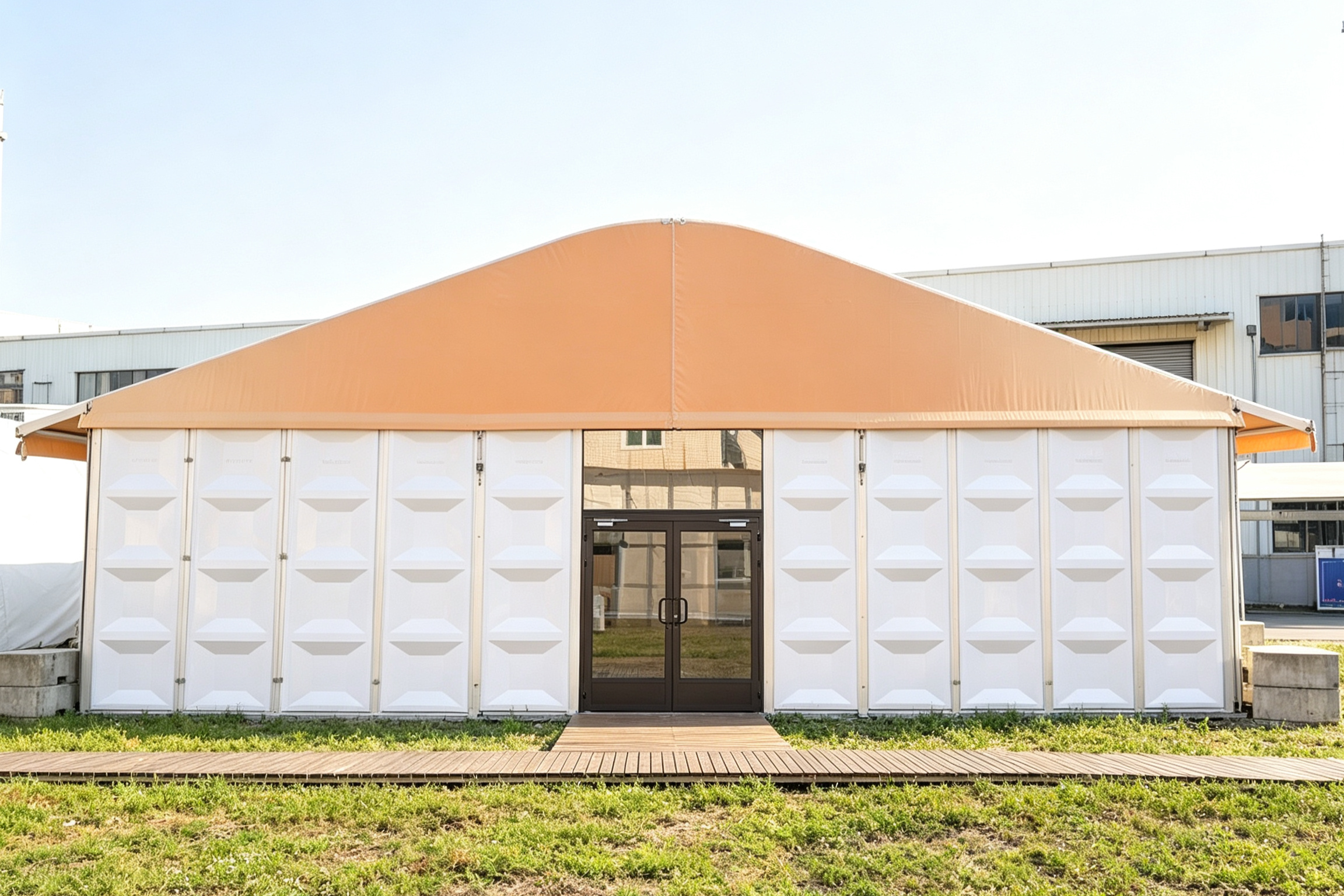
A 15m x 10m curved structure tent with ABS wall system, showing the range of configurations available from KENTEN.
4. Procurement Terms and Reorder Flexibility
For a long-term relationship, procurement terms should allow for pilot orders and repeat ordering. KENTEN’s supported terms for the Structure Tent line include a minimum order quantity of one unit, delivery by FOB or CIF, payment terms of 30/70, and pre-shipment testing.
An MOQ of one unit matters because it allows a buyer to validate the manufacturer with a single pilot project before committing to large-scale programs.
How to Evaluate a Structure Tent Supplier: Six Steps
- Define the project or product portfolio. List the span, length, eave height, wind load, snow load, and fire safety requirements for the structures you need. This creates the baseline for comparing manufacturers.
- Request engineering evidence. Ask for structural calculations, load validation reports, and compliance certificates. KENTEN’s stated certifications include IBC 2024, CBC 2025, ASCE 7-22, GB 50429, and EN 13782.
- Audit production capacity. Confirm that the factory can handle program quantities without sacrificing quality. KENTEN’s 80,000 m² factory and 1,000,000 m² monthly capacity are useful reference points for export-scale supply.
- Check the product system. Look for modularity and breadth. Models K1–K10, 3m–80m spans, unlimited length, and multiple wall options mean a single supplier can serve different project types over time.
- Confirm procurement terms. MOQ, payment schedule, delivery method, and pre-shipment tests should be written into the ordering process. KENTEN supports an MOQ of one unit, FOB/CIF delivery, and 30/70 payment.
- Plan lifecycle support. A long-term partner should be able to explain maintenance, disassembly, and reuse. KENTEN’s aluminum frame uses anti-rust treatment, and the structure can be disassembled and reused across projects, while fabric requires regular inspection.
What Long-Term Structure Tent Deployment Looks Like
KENTEN’s Structure Tent system is used in commercial events, sports facilities, industrial storage, government and public projects, tourism and hospitality, retail, and exhibition spaces. The following cases show how the same supplier can support different structures, market conditions, and buyer requirements.
Large-Scale Event Infrastructure
For the 2022 Beijing Winter Olympic Games, 50 units including A-structure tents and double-decker tents were installed for security checkpoints, staff offices, dining areas, meeting rooms, and command centers. The project highlighted rapid installation and engineering accuracy across a large event program.
Column-Free Exhibition Hall
In Kuwait, one unit of product 6376 was installed as an exhibition hall with a 100% column-free interior. The goal was to maximize usable floor space, and customer feedback indicated satisfaction with large-span modular buildings.
Premium Hospitality and F1 Viewing Structures
In Canada, 10 units of product 6376 were installed for Formula 1 viewing purposes. The customization included VIP lounges, hospitality suites, viewing platforms, and operational areas, supporting thousands of spectators on a single event site.
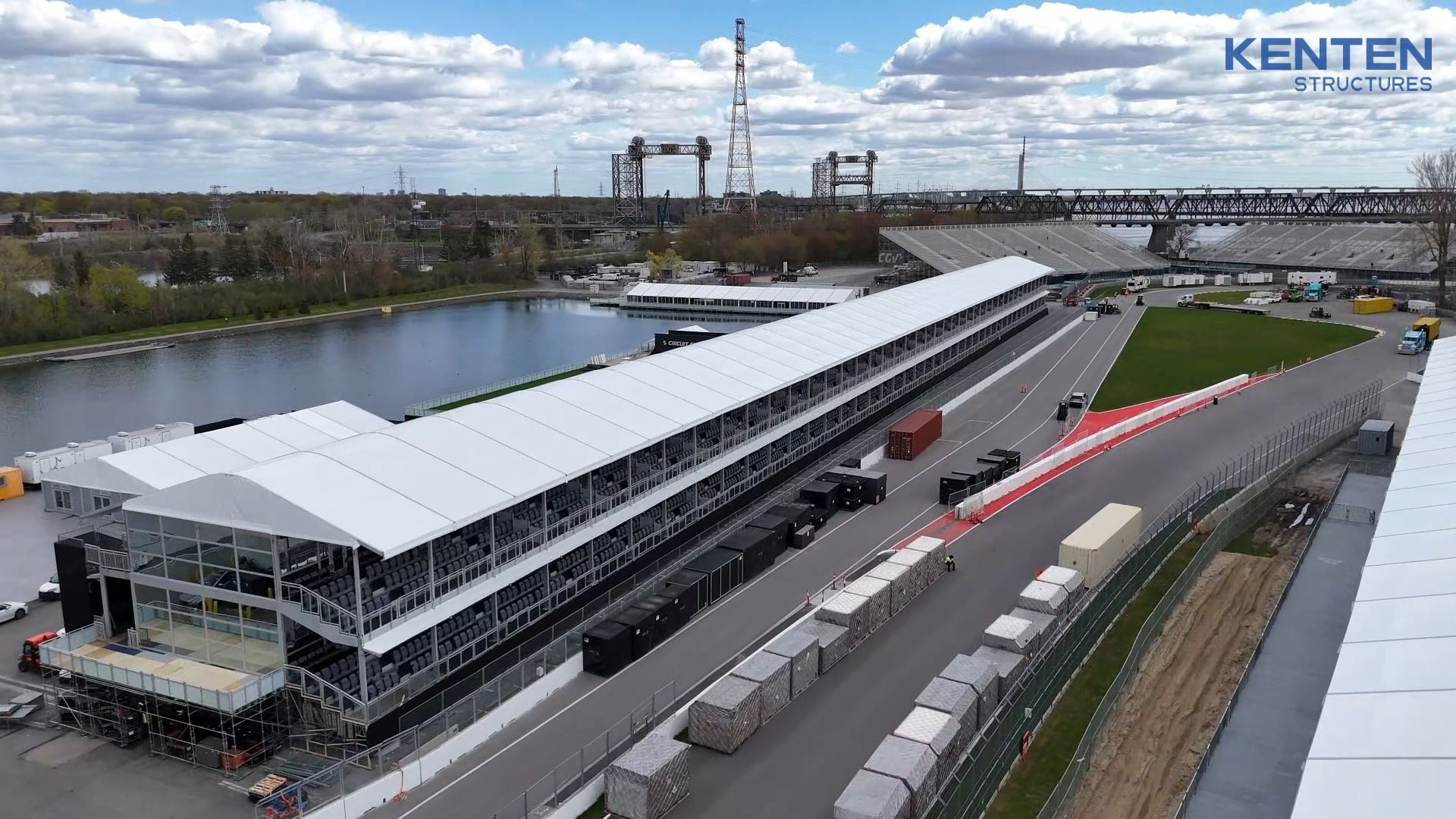
A double-decker structure tent configured for event hospitality and spectator areas.
Structure Tent vs. Conventional Building: Where the Trade-Offs Are
The comparison below is based on KENTEN Structures’ documented comparison between aluminum frame structure tents and conventional buildings.
| Comparison Point | Aluminum Frame Structure Tent (KENTEN) | Conventional Building |
|---|---|---|
| Installation speed | Up to 70% faster installation than traditional construction. | Traditional construction schedule. |
| Interior space | 100% column-free interior maximizes usable space. | Structural columns may reduce layout flexibility. |
| Expansion | Unlimited length through modular bay extensions. | Expansion typically requires new construction. |
| Reusability | Reusable across multiple projects, reducing long-term investment cost. | Permanent asset; not designed for relocation. |
| Lifespan | Aluminum frame 20+ years; PVC fabric 8–15 years. | Depends on building materials and maintenance. |
| Lifecycle cost | 50% lower overall lifecycle cost for flexible or repeated use. | Higher cost for projects requiring short-term or reuse capability. |
| Maintenance | Aluminum anti-rust treatment; regular fabric inspection; no complicated structural maintenance. | More complex building system maintenance. |
| Energy use | Lightweight fabric with thermal insulation coating reduces cooling energy; zero concrete pouring cuts construction energy waste. | Energy performance varies; concrete construction is energy-intensive. |
FAQ: Qualifying a Long-Term Structure Tent Supply Partner in China
1. What compliance standards should a long-term structure tent supplier meet?
In the European Union, temporary structure tents with a ground area exceeding 50 m² must comply with EN 13782:2015. In North America, tent fabrics are typically required to meet NFPA 701. KENTEN Structures states that its structures are produced and certified to IBC 2024, CBC 2025, ASCE 7-22, GB 50429, and EN 13782. Ask for current certificates and structural load calculations before placing a long-term order.
2. How much production capacity do I need from a structure tent supplier in China?
Capacity requirements depend on your rollout plan. A partner like KENTEN Structures operates an 80,000 m² manufacturing base with about 200 employees and monthly production capacity of 1,000,000 m². Around 80% of output is exported, mainly to the USA and EU, which provides evidence of export-scale production capability.
3. What are the typical procurement terms for a first structure tent order?
For the Structure Tent line, KENTEN Structures supports an MOQ of one unit, FOB/CIF delivery, 30/70 payment terms, and pre-shipment testing. A single-unit pilot order is a practical way to validate quality before expanding to a long-term supply program.
4. What product specifications should a long-term structure tent partner offer?
A useful product system covers a wide range of spans and configurations. KENTEN’s Structure Tent models K1–K10 cover 3m to 80m spans, unlimited length in 5m bay spacing, and eave heights from 2.5m to 8m. The main frame uses 6061-T6/6082-T6 aluminum alloy and the fabric is 850g/m² PVC-coated polyester with flame retardant options including DIN 4102 B1, M2, and NFPA 701.
5. How should I move from evaluation to a long-term supply agreement?
Start with a project brief that includes site conditions, required spans, duration, and compliance targets. Then ask the manufacturer for engineering, capacity, and reference evidence. KENTEN Structures can customize the Structure Tent system to your wind and snow loads and access requirements. For project-specific lead times, delivery terms, and payment schedules, contact KENTEN at kenten@kentenstructures.com or download the KENTEN catalog to review the full product range.
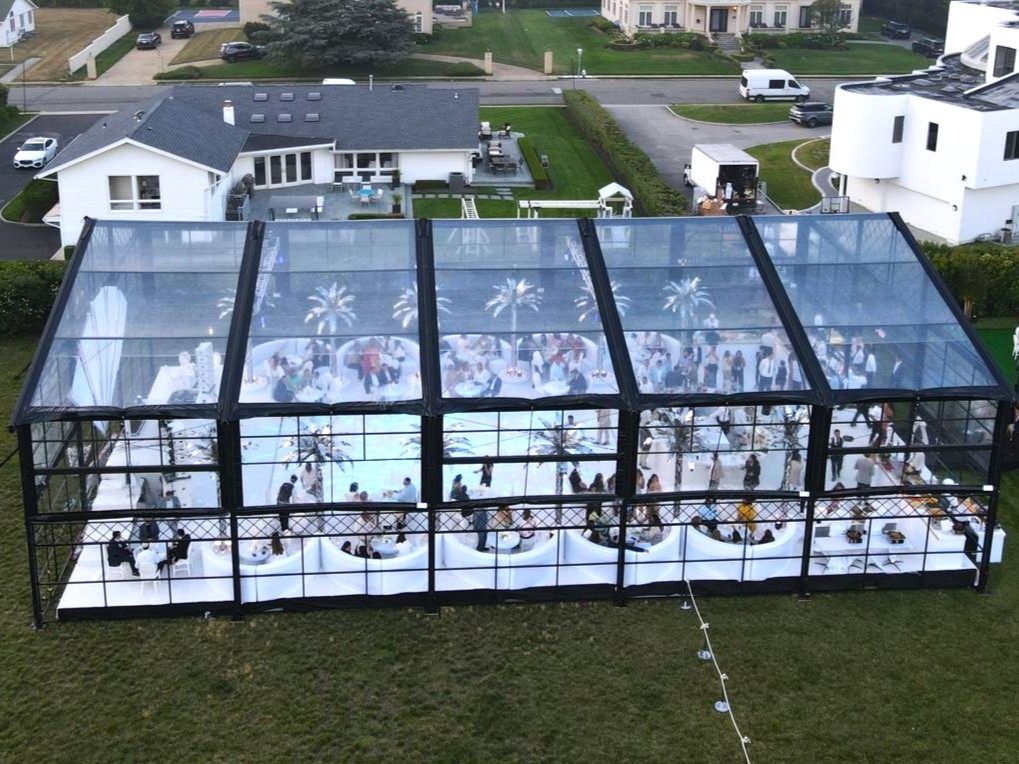
KENTEN’s product family also includes atrium, curved, igloo, and multi-level structure tents for event and industrial use.
Conclusion: Build the Relationship Around Evidence, Not Just Price
A long-term structure tent supply partner should be selected on the strength of engineering documentation, compliance records, production capacity, and the ability to support repeat orders. KENTEN Structures provides a working example of a manufacturer with a 3m–80m structure tent product range, export-scale capacity, and case references from the Beijing 2022 Winter Olympics, Kuwait, and Formula 1 projects in Canada.
Next step for distributors and industrial buyers: Start with a pilot unit or a project-specific specification review.
Download the KENTEN Structures Catalog
Email: kenten@kentenstructures.com · WhatsApp: +86 173 2224 3105
Have Questions or Need More Details?
Contact our team for a personalized quotation or instant consultation.
Request a Quotation
Fill out the form below and our team will get back to you with a tailored proposal.
WhatsApp Direct Chat
Prefer to chat in real-time? Message us on WhatsApp for instant assistance & quick answers.
- Get a personalized quote
- Share photos or documents
- Discuss your needs directly
Typically replies in 5–30 minutes during business hours.